

Estimated Time to Read: 8 minutes
Texas continues to rank among the most restrictive states in the nation for occupational licensing. According to the Archbridge Institute’s 2025 State Occupational Licensing Index, Texas ranks third-worst overall, trailing only Oregon and Tennessee. This ranking places Texas firmly in a category that contradicts its reputation for economic freedom and limited government.
The Archbridge index evaluates both the number of occupations licensed by a state and the extent to which occupational tasks are restricted by law. Texas scores near the maximum on both measures. Even after methodological updates that reduced the total number of occupations studied nationwide, Texas remains near the top of the rankings. That consistency suggests the problem is not statistical noise. It is structural.
The Archbridge Index Shows Texas Far Above National Averages
In 2025, Texas records 178 occupational barriers and 148 licensed occupations, compared to national averages of 159.1 barriers and 124.5 licenses. Those figures place Texas well above both national and regional norms, confirming that the state licenses more work and restricts more tasks than most of the country.
Within the West South Central region, Texas ranks worst among its peers. This matters because regional comparisons help control for shared economic conditions and labor markets. Texas’ ranking cannot be explained by geography or population size alone. It reflects a policy environment that relies heavily on licensing as a default regulatory tool.
Texas Licensing Data Shows Regulation at Massive Scale
The Archbridge rankings provide a useful national comparison, but Texas’s own administrative data makes the implications tangible. A review of licensing records from the Texas Department of Licensing and Regulation (TDLR) shows nearly one million license records tied to work performed in the state.
This licensing footprint is not limited to a narrow set of professions with clear and immediate public safety risks. Instead, the data shows that licensing in Texas is heavily concentrated in trades, personal services, and technical occupations such as electricians, HVAC technicians, cosmetology professionals, and related fields. These are occupations that often serve as entry points into the workforce or as pathways to independent work and small business ownership.
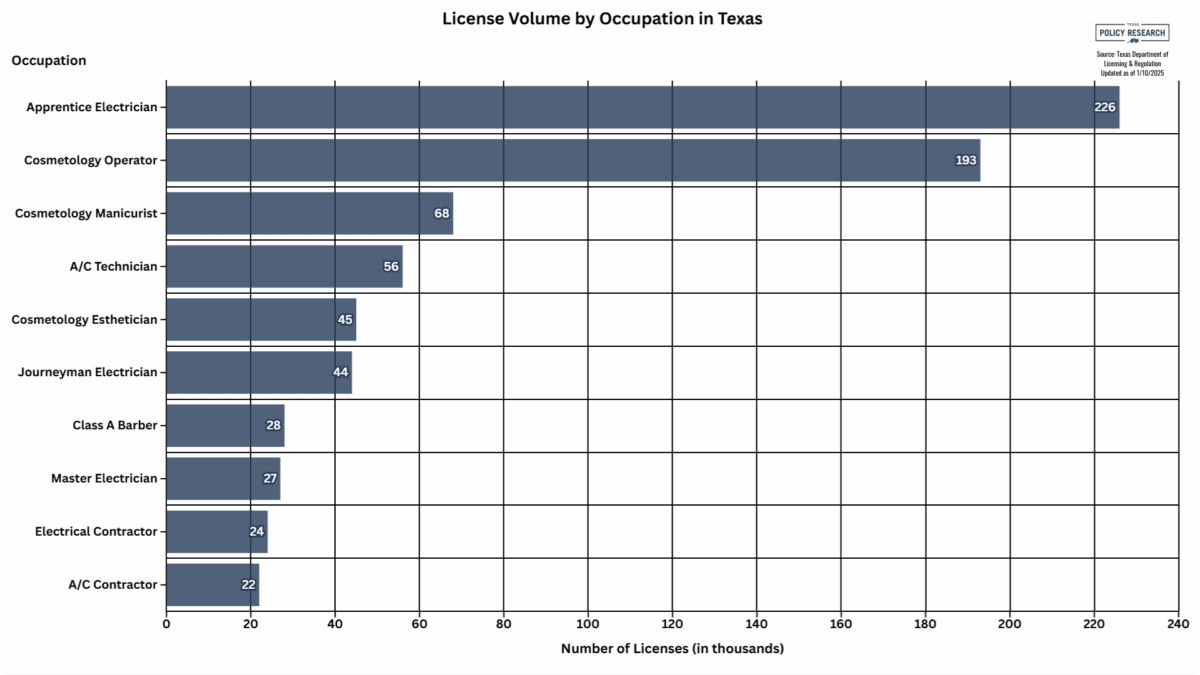
The scale alone is telling. Occupational licensing in Texas does not operate at the margins of the economy. It operates at the center of it.
Texas Licensing Regulates People More Than Facilities
The TDLR data also reveals who bears the brunt of this regulatory structure. A large majority of license records list the same mailing and business address, indicating that many license holders are independent operators, sole proprietors, or home-based workers rather than large commercial enterprises.
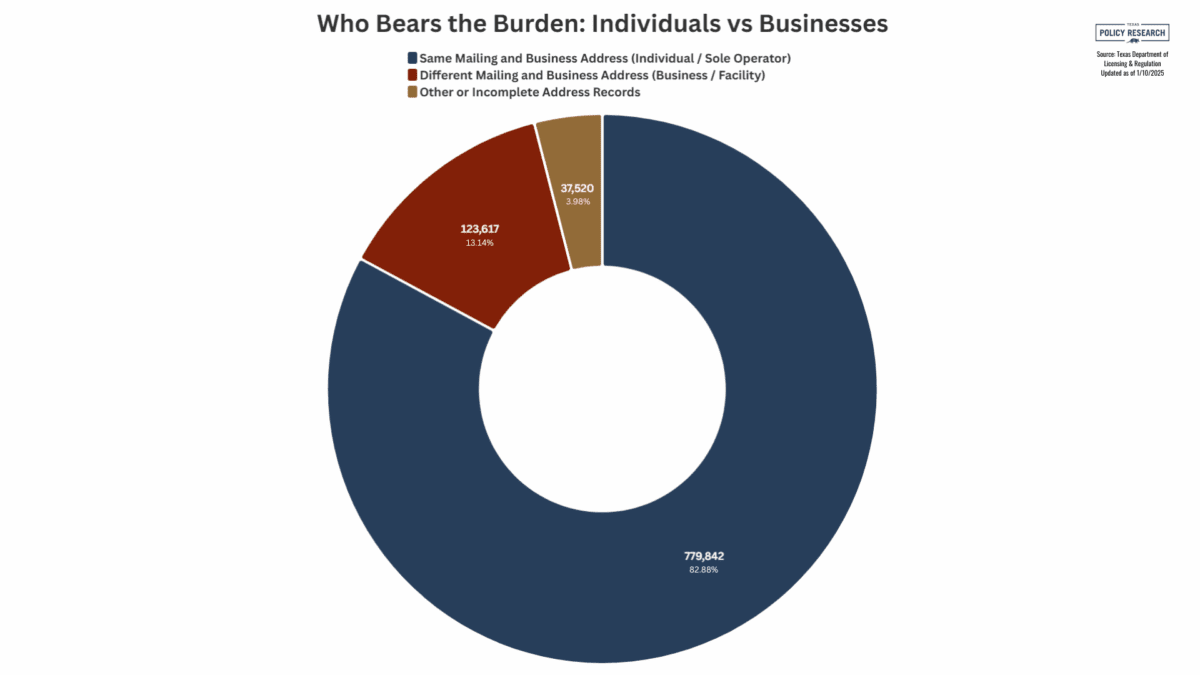
This distinction matters. When licensing requirements are imposed on individuals rather than facilities, compliance costs are not absorbed by corporate compliance departments. They are paid directly by workers in the form of education requirements, exam fees, renewal fees, continuing education mandates, and time spent navigating administrative processes. For lower-income Texans and those seeking upward mobility, these costs can be decisive barriers to entry.
Renewals and Continuing Education Create Ongoing Barriers
Occupational licensing in Texas is not a one-time hurdle. Expiration data shows a constant cycle of renewals across the state’s largest license categories. A substantial share of licenses expire each year, particularly in trades and personal service occupations, creating a recurring compliance burden that follows workers throughout their careers.
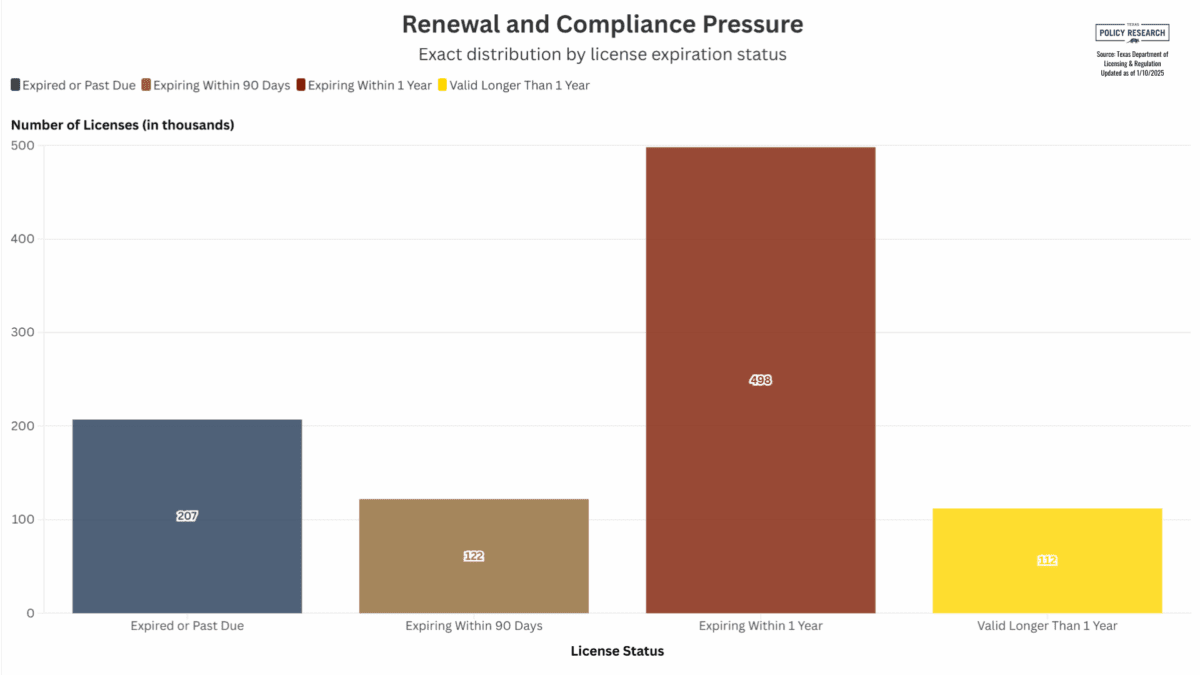
Continuing education requirements further compound this effect. While often justified as consumer protection measures, these mandates function in practice as recurring costs of participation in the labor market. They rarely appear in fiscal notes or agency budgets, but they impose real economic and time costs on workers and small operators.
Licensing Fees Fund the Regulatory Bureaucracy
Beyond the direct compliance burden imposed on workers, occupational licensing in Texas also functions as a self-reinforcing funding mechanism for the regulatory bureaucracy itself. Licensing fees, renewal fees, examination fees, and continuing education requirements do not simply regulate access to work. They generate a steady stream of revenue that supports the agencies and boards responsible for administering and enforcing those same regulations.
Data from the TDLR illustrates how large this system has become. With nearly one million license records tied to everyday work, even modest per-license fees translate into substantial agency revenue. These funds are used to support staffing, enforcement operations, compliance systems, and administrative overhead. In effect, workers are required to finance the very regulatory structure that conditions their ability to earn a living.
This dynamic creates a structural incentive problem. When regulatory agencies depend on licensing fees to sustain their operations, there is little institutional pressure to reduce licensing scope, streamline requirements, or eliminate unnecessary licenses. Instead, the system naturally favors expansion, renewal cycles, and ongoing compliance obligations that preserve revenue stability.
For individual workers, this means occupational licensing is not merely a barrier to entry. It is an ongoing financial obligation that helps perpetuate the bureaucracy governing their profession. For policymakers, it raises a fundamental question. If licensing regimes are funded by the workers they regulate, reform efforts must confront not only statutory requirements but also the financial incentives embedded in the system itself.
Recognizing this feedback loop is essential for meaningful occupational licensing reform. Without addressing how licensing fees are used and how agencies are funded, Texas risks preserving a regulatory structure that prioritizes institutional maintenance over genuine public protection.
Texas Has Not Adopted Universal License Recognition
As of 2025, 28 states have adopted some form of universal occupational licensing recognition, allowing workers licensed in other states to more easily enter the workforce when they relocate. Texas has not adopted such a policy.
The absence of universal recognition leaves Texas less accessible to skilled workers moving from other states and reinforces the state’s high ranking in national indices. Even among states that have adopted recognition laws, the Archbridge index shows that effectiveness varies depending on restrictions and residency requirements. Texas has avoided these implementation questions entirely by declining to act.
Texas License Recognition Remains a Patchwork
While Texas has not adopted a comprehensive universal occupational licensing recognition law, the state has enacted limited legislation recognizing certain out-of-state licenses under specific circumstances. These measures typically apply only to particular professions, particular states, or narrowly defined licensing regimes. In practice, this has produced a patchwork system rather than a consistent statewide policy.
This selective recognition approach creates uneven outcomes for workers. Two professionals with similar training and experience may face entirely different regulatory hurdles depending on the occupation they practice, the state they are relocating from, or which licensing board has jurisdiction. The result is not broad labor mobility, but regulatory uncertainty layered on top of an already complex licensing system.
From a policy perspective, this piecemeal strategy reflects an attempt to mitigate licensing barriers without confronting the underlying structure that creates them. Rather than reassessing whether licensing is necessary in the first place, the state has chosen to carve out exceptions that leave the broader system intact. That approach may provide relief in isolated cases, but it does not meaningfully reduce the overall licensing burden identified in national rankings or reflected in Texas’s own administrative data.
The Archbridge Institute’s 2025 State Occupational Licensing Index underscores this limitation. States that have adopted true universal recognition without restrictive conditions consistently perform better in terms of licensing burden. Texas’s continued ranking near the top suggests that selective recognition has not altered the fundamental dynamics of occupational regulation in the state.
If Texas is serious about improving labor mobility and reducing unnecessary barriers to work, reform must move beyond occupation-by-occupation exceptions. A coherent, statewide framework would provide clarity for workers, reduce administrative complexity, and address the structural incentives that perpetuate licensing expansion.
What the Data Means for Occupational Licensing Reform in Texas
Taken together, the Archbridge index and Texas’s own licensing data tell the same story. Occupational licensing in Texas has expanded far beyond narrowly tailored public safety regulation. It now functions as a broad regulatory system governing everyday work for hundreds of thousands of Texans.
Incremental reforms have not meaningfully altered this reality. While some licenses have been eliminated or modified over time, the overall footprint remains among the largest in the nation. Any serious effort to address occupational licensing must move beyond isolated changes and toward a systematic review of whether licensing is justified at all, particularly for low-risk, high-volume occupations.
Conclusion: The 90th Legislature Must Address Licensing Reform
Texas’ third worst ranking in the 2025 State Occupational Licensing Index confirms what state licensing data already makes clear. Occupational licensing remains one of the most significant and least examined barriers to work in Texas.
As lawmakers prepare for the 90th Legislative Session in 2027, occupational licensing reform should be addressed directly rather than deferred or fragmented. The data provides lawmakers with a clear roadmap. Texas licenses too many occupations, restricts too many tasks, and imposes ongoing compliance burdens that fall hardest on entry-level workers and independent operators.
If Texas intends to preserve economic opportunity, workforce flexibility, and genuine competition, occupational licensing reform must move from a secondary policy concern to a central legislative priority.
Texas Policy Research relies on the support of generous donors across Texas.
If you found this information helpful, please consider supporting our efforts! Thank you!

