

Estimated Time to Read: 9 minutes
Texas is once again in the middle of a major transportation conversation, and this time the discussion centers on whether the state could see two entirely new interstate corridors built over the next several decades. While Texans are familiar with continuous population growth and the resulting strain on transportation networks, the scale of the projects under consideration is unusually large. Between the federally authorized I-14 System and the Texas Department of Transportation’s (TxDOT) new study on converting US 287 into an interstate, Texas could be looking at some of the most significant highway developments since the original Interstate Highway System.
These proposals come at a time when Texans are increasingly aware of the rising cost of infrastructure, the limits of government funding, and the long-term financial obligations tied to mega-projects that unfold over decades. The promise of new interstates often sounds appealing, but the reality involves federal designation hurdles, environmental reviews, land acquisition, and enormous construction costs that taxpayers ultimately bear. Understanding these projects requires comparing the benefits they offer with the concerns raised by both residents and fiscal watchdogs.
What follows is a comprehensive look at the I-14 System’s progress and the future of US 287 as a potential interstate, drawing from TxDOT’s official planning documents, public engagement summaries, and statewide projections.
Texas Interstate Expansion: A New Era of Large-Scale Corridor Planning
The concept of expanding Texas’s interstate footprint begins with the I-14 System, a multi-state corridor authorized in the FAST Act of 2015 and expanded in the Infrastructure Investment and Jobs Act of 2021. In Texas alone, the system is projected to span more than one thousand miles and rely on upgrading existing highways to interstate standards. According to TxDOT’s I-14 Implementation Plan, the corridor is envisioned to connect urban and rural regions, military installations, freight hubs, ports, and major energy sectors across the state.
At the same time, a separate TxDOT study completed in 2025 evaluated whether US 287 should become a new interstate corridor stretching from the Panhandle through the Dallas–Fort Worth region and down to Port Arthur. The study concluded that the conversion is economically feasible and could generate significant GDP growth and job creation by 2050, while relieving congestion on existing interstates such as I-10, I-20, and I-45.
Together, these two initiatives position Texas for a transformative change in its transportation network. Yet both come with steep costs and long timelines, raising the question of how much taxpayers should shoulder and whether these projects represent the best use of limited transportation dollars.
Understanding the I-14 System in Texas
Before weighing whether Texas should pursue two major corridor projects, it is important to understand what each proposal actually involves. The I-14 System is already federally authorized but remains largely unbuilt, and its long-term development depends on incremental upgrades, local input, and substantial funding. Examining the I-14 plan helps set the stage for understanding the scale and implications of Texas’ potential interstate expansion.
What the I-14 System Actually Is
The I-14 System is not a single road but a network of connected highways stretching across Texas. It is built by incrementally upgrading existing facilities such as US 190, US 83, US 87, US 96, US 69, and several others. TxDOT’s 2024 Implementation Plan stresses that I-14 will be developed over decades and that only twenty-five miles are currently designated as interstate between Belton and Copperas Cove.
The plan breaks the project into near-term, mid-term, and long-term phases, with many segments requiring future location studies before alignment or environmental impacts can even be determined. Several regions require complex studies due to environmental constraints, existing development, or sensitive cultural areas, including the Alabama-Coushatta Tribe of Texas Reservation and state parks.
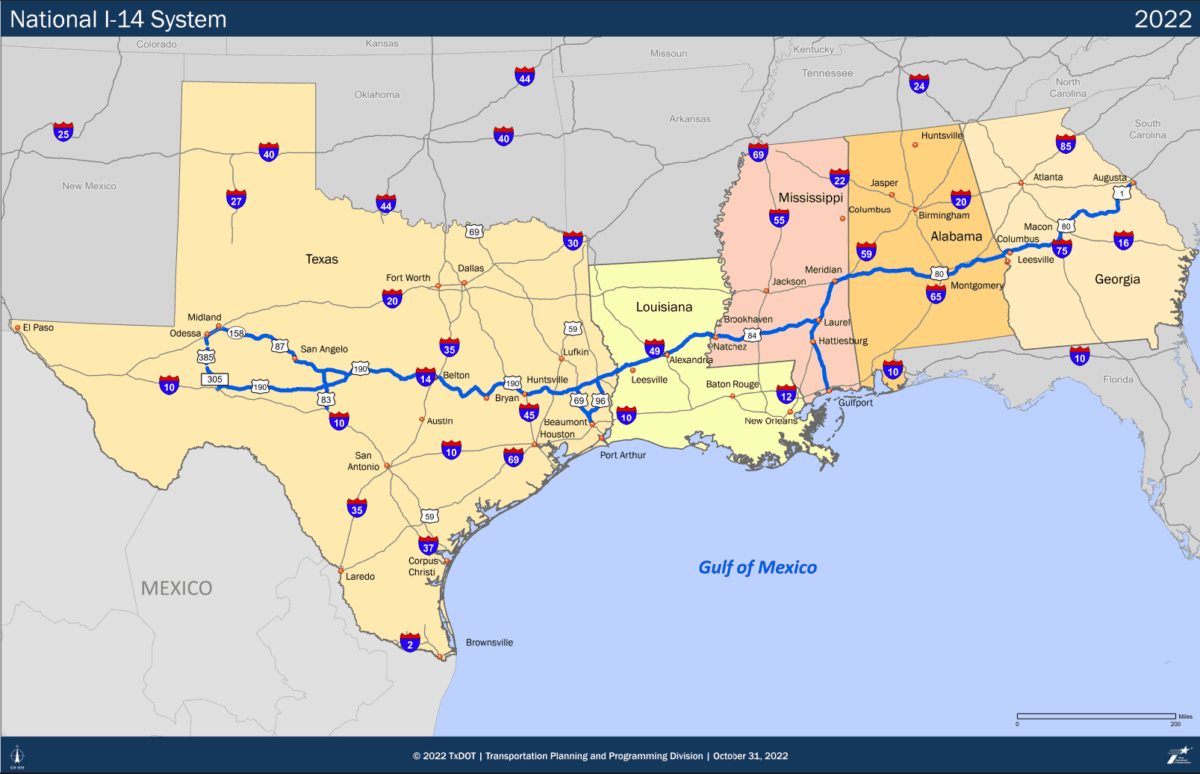
Source: TxDOT National I-14 System Map
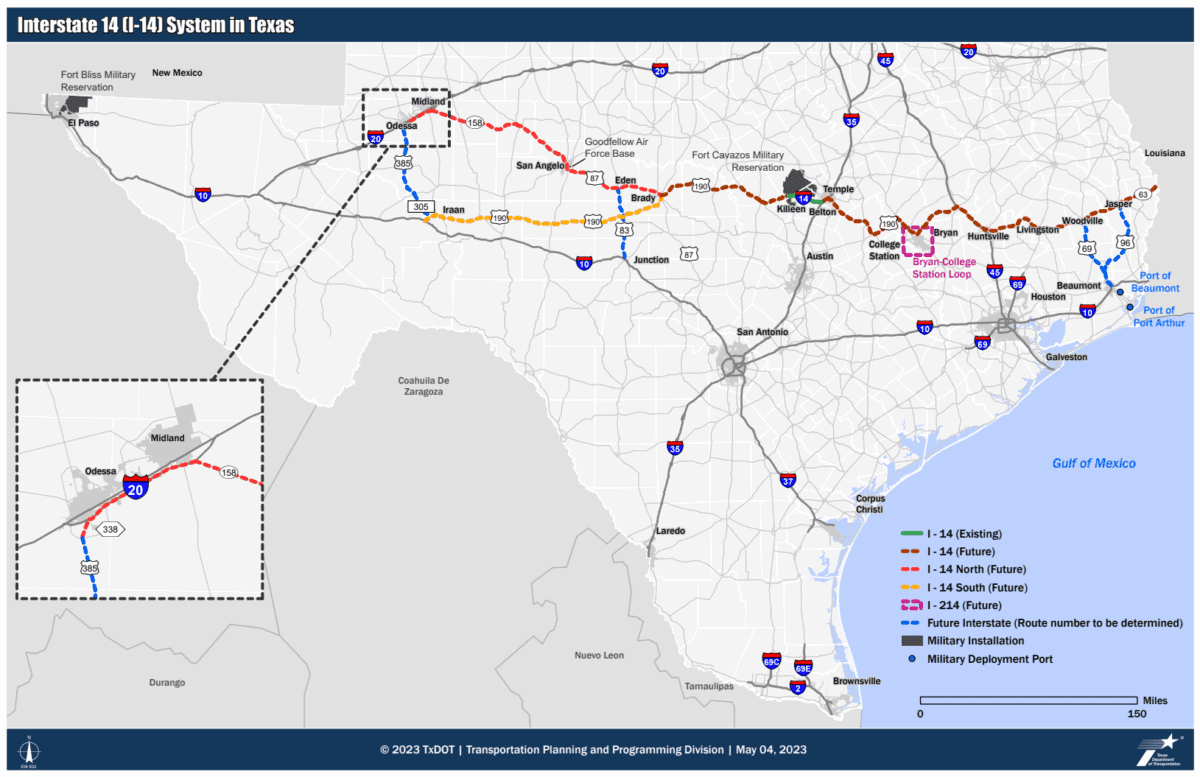
Source: TxDOT I-14 System in Texas Map
Public Feedback Highlights Significant Concerns
During TxDOT’s public engagement efforts in 2023, more than twelve hundred comments were collected through surveys, emails, and interactive maps. The feedback reveals a mixed public response. Survey respondents identified improved mobility, reduced travel time, job creation, and freight efficiency as top benefits, but environmental concerns dominated the interactive map, with nearly four hundred comments referencing impacts to state parks, wildlife, waterways, and natural resources.
The most frequently mentioned sites included Martin Dies Jr. State Park and Big Thicket National Preserve, where residents worried that new interstate-level construction would degrade natural habitats and recreational areas. Many participants also raised questions about displacement, right-of-way acquisition, and whether routing decisions would impose costs on small communities. These concerns reflect not only environmental values but also deeper skepticism about whether such a large undertaking is necessary or prudent.
The Promise and Limits of Economic Opportunity
TxDOT’s I-14 Implementation Plan argues that the interstate would support several of Texas’s core industries, including energy production in the Permian Basin, timber and agriculture in East Texas, and military activity at Fort Cavazos and Goodfellow Air Force Base. The plan also emphasizes the corridor’s value as a hurricane evacuation route and its potential to improve freight movement from ports in southeast Texas.
However, the economic case depends heavily on long-term assumptions about population growth, freight demand, and national defense logistics. These projections may justify consideration, but they do not negate the fiscal reality that TxDOT acknowledges directly. There is currently no dedicated funding source for the I-14 System. Every segment must compete with other statewide projects for limited funds.
From a taxpayer perspective, this reality matters. A corridor built in increments over several decades risks consuming resources that could otherwise be used for more immediate needs, such as safety improvements, maintenance, or congestion relief in rapidly growing metro regions.
The US 287 Interstate Proposal: A Separate, Large-Scale Project
While I-14 moves through its federal authorization and long-range planning stages, TxDOT is also evaluating whether US 287 should become a new interstate corridor. According to the 2025 feasibility study, the cost to upgrade the 671-mile route to interstate standards would be approximately $24.5 billion. The study projects that the upgrade could create 46,885 jobs and generate $11.6 billion in GDP gains by 2050.
The corridor currently serves major economic sectors such as energy, agriculture, timber, and maritime shipping, in addition to providing access to military ports in Beaumont and Port Arthur. By converting the route into a limited-access interstate facility, TxDOT estimates an average travel-time savings of 44 minutes for drivers traveling its full length.

Source: TxDOT US 287 Interstate Feasibility Study
The Cost and Funding Gap
Despite the potential benefits, the feasibility study highlights two unavoidable barriers. First, US 287 cannot become an interstate without a congressional designation, a process that historically takes years and often requires broad political consensus. Second, there is no dedicated state or federal funding source for new interstate construction, meaning the project would compete with every other transportation priority in Texas.
When placed alongside the I-14 System, the US 287 proposal represents another massive financial commitment. Building two new interstate corridors simultaneously, even over decades, would place enormous pressure on TxDOT’s budget and on taxpayers who already bear the burden of ever-growing transportation obligations.
Comparing the Two Projects: Similar Benefits, Similar Challenges
Texas has long relied on strategic infrastructure investment to support growth, and when the government focuses on core responsibilities rather than expanding far beyond them, transportation can be one of the most legitimate and beneficial areas for public spending. Even with that belief, projects of this scale demand careful prioritization to ensure that taxpayer dollars are used wisely and produce measurable returns.
Both the I-14 System and the proposed US 287 interstate offer similar advantages. They promise faster travel, higher freight capacity, improved military mobility, and greater access to markets. They also share significant challenges. Each project faces high construction costs, complex environmental considerations, potential displacement, and the need for federal interstate designation. Neither has a dedicated funding source, meaning project segments advance only when dollars become available, which could stretch timelines far beyond 2050.
From a fiscal responsibility standpoint, the sheer scale of these undertakings raises questions about prioritization. Texas must balance its desire for economic development and mobility improvements with the responsibility to avoid overcommitting taxpayer funds. Long-term interstate plans can quickly become unfunded liabilities if costs grow faster than projected or if inflation outpaces state revenue.
A Future With Two New Interstates: Is It Worth It?
Texas lawmakers and transportation officials face a central question. Does the long-term value of adding these interstate corridors outweigh the financial, environmental, and community impacts identified in TxDOT’s studies?
Supporters argue that both corridors would stimulate economic growth, create jobs, strengthen national defense readiness, and improve freight mobility in one of the fastest-growing states in the country. Those benefits are real and worth considering.
However, public feedback collected by TxDOT reveals deeper concerns, particularly relating to environmental preservation, small-town character, land use, and the cost of massive infrastructure expansions. Many Texans are apprehensive about displacing communities, cutting through natural areas, or routing interstates near sensitive cultural or tribal lands. Others question whether building new highways is the best way to address 21st-century transportation needs.
Given the scale of the proposals, transparency and thoughtful prioritization are essential. Texas must ensure that each dollar spent reflects real mobility benefits rather than political ambition or federal incentive structures. Strategic infrastructure investment is valuable, but only when it delivers measurable improvements while respecting the rights of communities and taxpayers.
A Turning Point for Texas Transportation Policy
Whether Texas ultimately builds one or both of these corridors, the next decade will be critical in shaping the state’s transportation future. The I-14 System is federally authorized but still decades from completion, with significant portions requiring further study, environmental clearance, and public input. The US 287 interstate concept is promising on paper, but awaits political approval and a viable funding strategy.
Texas must weigh these opportunities against their costs and against the immediate needs of its existing roadway network. Growth alone does not justify large-scale spending without clear fiscal responsibility. As these projects continue through planning phases, Texans should demand transparency, careful analysis, and a commitment to ensuring that infrastructure investment enhances mobility without compromising local communities or overburdening taxpayers.
Two new interstate highways by 2050 are possible. Whether it is practical or prudent is another question entirely.
Texas Policy Research relies on the support of generous donors across Texas.
If you found this information helpful, please consider supporting our efforts! Thank you!

