


Estimated Time to Read: 3 minutes
In Texas, we like to lead, but in some cases, it would be better to be last. Local government debt is one of those cases. Unfortunately, Texas currently ranks third among the most indebted large states, behind only California and New York.
This November, Texans will again be asked to approve billions more in new local borrowing. According to the Texas Bond Review Board, voters across the state will consider roughly $32.4 billion in proposed bond issuances. These propositions range from essential infrastructure projects, such as water and sewer systems, to new stadiums, parks, and technology upgrades.
School District Bonds
Lamar Consolidated ISD's $1.9 Billion Bond Package
The Lamar Consolidated Independent School District (Lamar CISD) is presenting voters with a four-part bond package totaling more than $1.9 billion:
- Proposition A: New Schools and Facility Improvements – $1,903,490,000
- Proposition B: Stadium Repairs – $26,740,000
- Proposition C: Technology Equipment Refresh – $44,130,000
- Proposition D: Student Device Initiative – $10,690,000
Source: Lamar CISD Bond Information Site
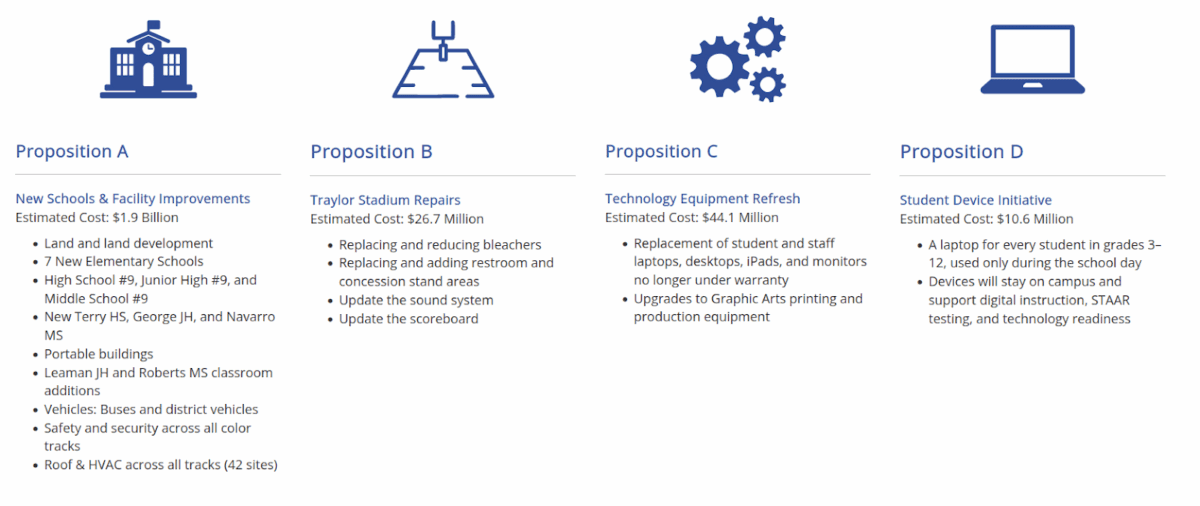
Screenshot from the Lamar CISD bond information site
If approved, this would be one of the largest school bond issuances in Texas this year—adding to a statewide trend of escalating education-related debt.
Special Purpose Districts: Hidden Costs in Fine Print
Many special-purpose districts, such as Municipal Utility Districts (MUDs), often fall under the radar of public attention. However, their bond proposals can be substantial.
Seven Springs MUD's $1.3 Billion Proposal
This district is asking voters to approve two bonds totaling more than $1.3 billion, including:
- Proposition B: Water, Sewer, and Drainage – $869,890,000
- Proposition D: Roads – $504,715,000
These projects, while infrastructure-oriented, contribute to Texas’s growing local government debt burden, costs that taxpayers ultimately shoulder through higher property taxes and utility rates.
Support Our Work
Help us keep producing free, independent research on Texas policy.
Stay in the Loop
Get new research and event updates delivered to your inbox.
Municipal Bonds: Prosper's $192 Million Wish List
City of Prosper Bond Propositions
The City of Prosper is proposing six bonds totaling just over $192 million, covering a wide range of projects:
- Proposition A: Streets – $92,800,000
- Proposition B: Police – $29,000,000
- Proposition C: Library – $34,200,000
- Proposition D: Parks and Recreation – $24,000,000
- Proposition E: Public Works and Parks Service Center – $10,000,000
- Proposition F: Downtown Improvements – $2,300,000
Source: City of Prosper bond information site


Screenshot from the City of Prosper bond information site
While some of these may address legitimate community needs, voters should weigh whether each expenditure reflects a true public necessity or a “nice-to-have” amenity.
County Bonds: Parker County's $286 Million "Justice Bond"
Courthouse and Jail Expansion on the Ballot
Parker County is asking voters to consider two bond propositions totaling more than $286 million, described as a “Justice Bond” package:
- Proposition A: Justice Center – $181,605,000
- Proposition B: Jail Expansion Project – $104,755,000
Source: Parker County bond information site

Screenshot from the Parker County bond information site
These projects would add substantial debt obligations for local taxpayers, even as many counties continue to experience rising operational costs and population pressures.
Before You Vote: Key Questions for Texas Taxpayers
Local governments have many legitimate functions, and those responsibilities must be funded. However, taxpayers should always expect fiscal discipline and efficiency from the entities that collect and spend their money.
Before approving new debt, voters should ask:
- Is this borrowing truly essential to core government functions?
- Is it a need, or simply a want?
- Are there alternative funding sources that could address the issue without taking on new debt?
Too often, we lose sight of the proper role of government, confusing it with the roles of families, private enterprise, or charitable organizations.
At Texas Policy Research, we are guided by five foundational liberty principles: Individual Liberty, Personal Responsibility, Free Enterprise, Private Property Rights, and Limited Government.
This November, the question for voters is simple: Will more public indebtedness enhance or diminish the liberty that Texans should expect to enjoy?
Note: The statewide total above does not include “refunding” bonds.
Support Our Work
Texas Policy Research relies on generous donors across Texas. If you found this helpful, please consider supporting our efforts.
Donate TodayStay in the Loop
Subscribe for occasional emails with new research, event details, and ways to engage with Texas policy.
Subscribe for Updates
