


Estimated Time to Read: 5 minutes
Texans now have a direct line to state government through a newly launched Regulation Evaluation Portal, operated by the Texas Regulatory Efficiency Office (TREO). The portal allows individuals, business owners, and members of the regulated community to submit feedback on state rules that affect them, marking a new era of public participation in Texas rulemaking.
Visitors to the portal, hosted on the Governor’s official website, can describe specific regulations they believe are outdated, burdensome, or redundant. Submissions can include examples of how the rule increases costs, creates duplication, or limits opportunity. The office will review the feedback and coordinate with agencies to determine whether reform is warranted.
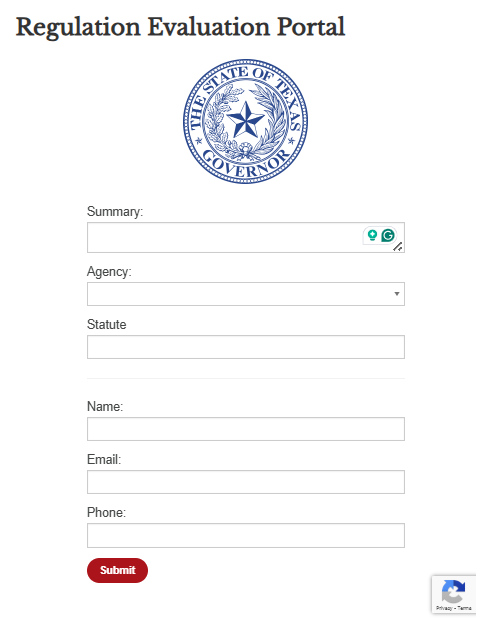
For small businesses and professionals navigating Texas’s complex web of licensing, reporting, and compliance requirements, this portal could become a practical outlet to highlight inefficiencies that lawmakers and agencies might otherwise overlook. In theory, it is an open invitation for Texans to help shape a more responsive and accountable regulatory system.
How the Portal Fits into Senate Bill 14
The portal was created as part of Senate Bill 14 (SB 14), the Regulatory Reform and Efficiency Act, which became law earlier this year. The law established the Texas Regulatory Efficiency Office within the Governor’s Office to review state agency rules, reduce regulatory burdens, and improve transparency.
Under the statute, TREO is responsible for identifying unnecessary rules, assisting agencies in simplifying procedures, and publishing plain-language guides to help both government employees and the public understand regulatory costs and impacts. The new portal serves as the public-facing component of that mission, a single location where Texans can submit their experiences directly instead of navigating dozens of separate agency systems.
By coordinating with the Secretary of State and the Department of Information Resources, TREO is also required to build an interactive statewide website where users can search rules by industry, topic, or activity. The Regulation Evaluation Portal is the first tangible step toward that larger goal.
Why Public Input Matters
For years, rulemaking in Texas has largely been an internal process, open to comment only during formal agency hearings or through technical filings. The TREO portal changes that dynamic by offering a standing opportunity for citizens to participate. It recognizes that the people living under the rules often see their flaws most clearly.
Transparency of this kind can produce better regulation. When feedback comes from the real-world experiences of taxpayers, entrepreneurs, and workers, it gives policymakers data that goes beyond bureaucratic assumptions. It also helps agencies focus on which rules deliver real public benefits and which merely consume time and resources.
A Promising Tool, Born from a Risky Strategy
The creation of the portal deserves praise. Texans have long needed a straightforward way to highlight redundant or outdated regulations. Giving citizens a seat at the table aligns with the state’s broader commitment to limited government and accountability.
Yet, it is difficult to separate the portal’s promise from the structure that produced it. TREO itself is a new bureaucracy created to make the existing bureaucracy more efficient. In an era some have described as the “age of DOGE”, Departments, Offices, Grants, and Entities, Texas lawmakers responded to administrative inefficiency by adding another administrative layer.
That irony is hard to ignore. TREO could become an important catalyst for reform, but it could also drift into the very pattern it was designed to correct. The office begins with an annual operating cost of nearly eight million dollars, dozens of new employees, and broad authority to “coordinate” with other agencies. Unless it measures success by the number of rules it helps eliminate rather than the reports it produces, the experiment risks reinforcing, not reducing, government sprawl.
Cautious Optimism for a New Era of Transparency
Despite these concerns, the portal itself is an encouraging step toward greater openness. Texans can now use the platform to flag costly or confusing rules and track whether state agencies respond. If TREO manages its mission responsibly, focusing on measurable regulatory reduction rather than self-preservation, the tool could become a genuine model for citizen-driven reform.
Lawmakers should monitor its progress closely. Early public engagement, clear performance metrics, and an independent sunset review within five years would help ensure the office fulfills its purpose. Texans should also hold TREO accountable by using the portal often and demanding evidence that their input leads to action.
Conclusion: Opportunity Wrapped in Bureaucracy
The launch of the TREO Regulation Evaluation Portal gives Texans something they have not had before: a direct channel to challenge excessive regulation. It embodies the idea that government should listen before it regulates.
Still, as with many reforms, the messenger matters as much as the message. In building a new office to manage efficiency, the state has created an experiment in whether bureaucracy can discipline itself. Texans should seize the opportunity to use the portal, but they should also watch closely to see whether the office that runs it practices what it preaches.
The portal is a win for transparency. Whether TREO itself becomes a win for efficiency remains to be seen.
Support Our Work
Texas Policy Research relies on generous donors across Texas. If you found this helpful, please consider supporting our efforts.
Donate TodayStay in the Loop
Subscribe for occasional emails with new research, event details, and ways to engage with Texas policy.
Subscribe for Updates
