


Estimated Time to Read: 19 minutes
Texas government has accumulated an enormous contracting footprint. The Legislative Budget Board's (LBB) Contracts Database contains more than 270,000 reported contracts involving 190 state agencies and institutions. Nearly 57,000 of those remain active, carrying a reported value of approximately $599.22 billion.
That active figure is the one lawmakers should focus on. The database's headline total, roughly $930.92 billion across all records, stretches across six decades and includes contracts completed years ago. It reflects reported contract value rather than annual state spending. The LBB describes the database as a repository for contracts meeting reporting thresholds established by state law and the General Appropriations Act (GAA), not as a comprehensive accounting of every transaction made by state government.
Even within those narrower bounds, the database raises a question that goes beyond any particular contract. Texas already collects an extraordinary amount of procurement information. Is state government making full use of it to protect taxpayers?
The question is timely. The House Committee on Delivery of Government Efficiency is examining how technology, including artificial intelligence (AI), could help Texas prevent fraud, waste, and abuse. When the Senate Finance Committee took up the same subject in July, its interim charge specifically identified contracted services and technology contracts as high-risk areas and directed lawmakers to evaluate the state's use of data analytics, reporting mechanisms, and financial recoveries.
The Money Is Not Spread Evenly
The dollars in the LBB database are concentrated to a degree that ought to shape how Texas allocates oversight attention.
Half of Texas Contract Value Sits in 83 Agreements
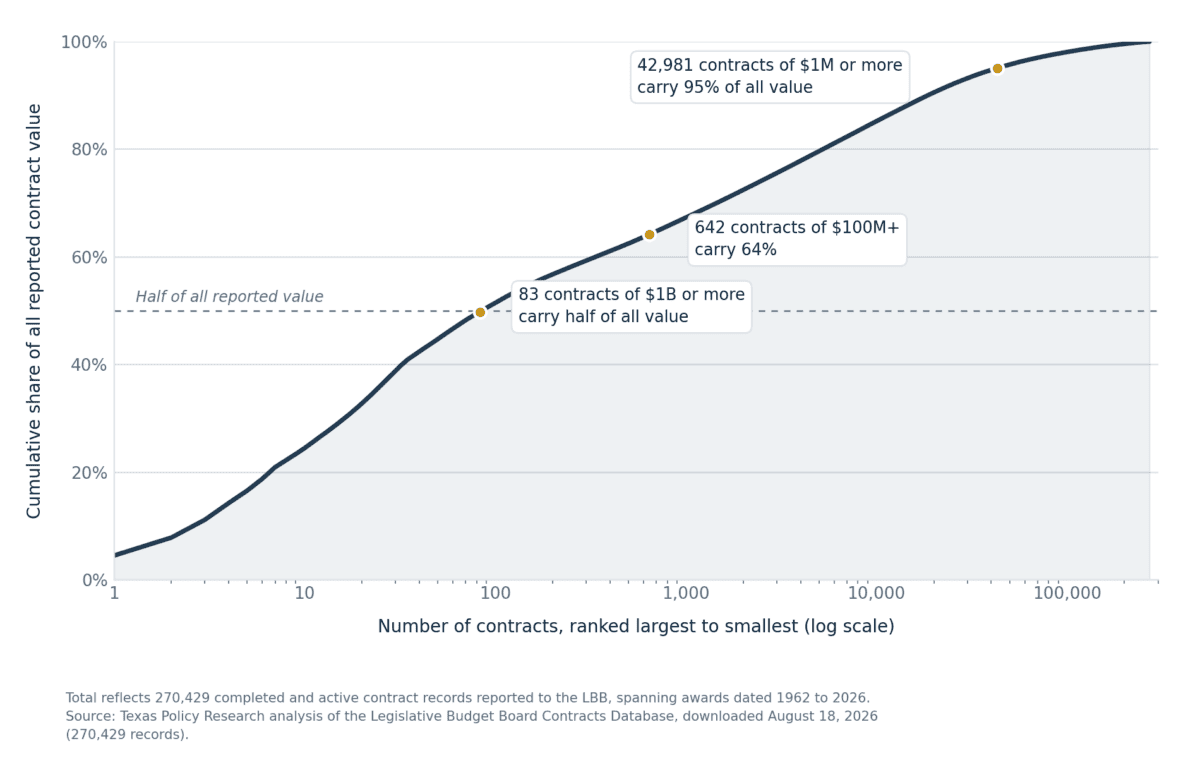
Just 83 individual contract records carry reported values of $1 billion or more, and those 83 agreements account for nearly half of all reported value in the database. Widen the field and the pattern holds: 642 contracts worth at least $100 million account for approximately 64 percent of reported value, and contracts valued at $1 million or more account for roughly 95 percent despite representing fewer than one in six records. The median active contract is worth $300,000. The largest is worth $42.07 billion.
The same concentration appears when the data is cut by agency rather than by contract.
One Agency Holds More Than Half of All Texas Contract Value
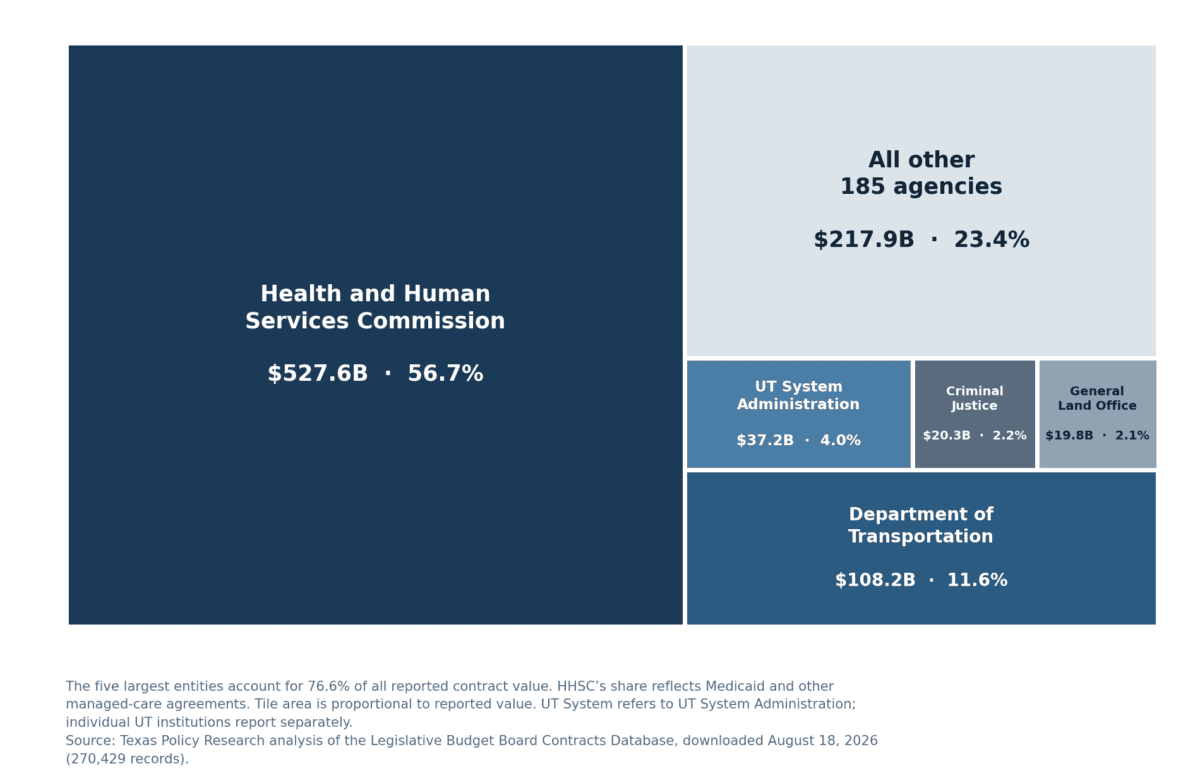
The Texas Health and Human Services Commission (HHSC) accounts for approximately $527.6 billion in reported contract value, or about 57 percent of the statewide total. Many of the database's largest individual records involve Medicaid and other managed-care contracts worth billions or tens of billions of dollars. The Texas Department of Transportation (TxDOT) follows at approximately $108.2 billion, the University of Texas System Administration at $37.2 billion, the Texas Department of Criminal Justice (TDCJ) at roughly $20.3 billion, and the General Land Office (GLO) and Veterans' Land Board (VLB) at approximately $19.8 billion. Those five entities represent more than three-quarters of all reported contract value. The remaining 185 agencies split the rest.
Agencies administering Medicaid, highways, universities, and prisons will naturally oversee substantial contracts. But concentration magnifies risk, and it means a system treating a $100,000 procurement and a multibillion-dollar agreement as equivalent financial exposure is not making the best use of limited auditing resources.
Texas has already recognized part of this. Of the $234.1 million appropriated for independent Offices of Inspector General at four state agencies for the 2026–27 biennium, $158.5 million is assigned to Health and Human Services.
The Largest Exposure Sits in Decade-Old Contracts
Concentration by size and by agency is only part of the picture. The state's dollar exposure is also concentrated in time, and not in the direction most people would assume.
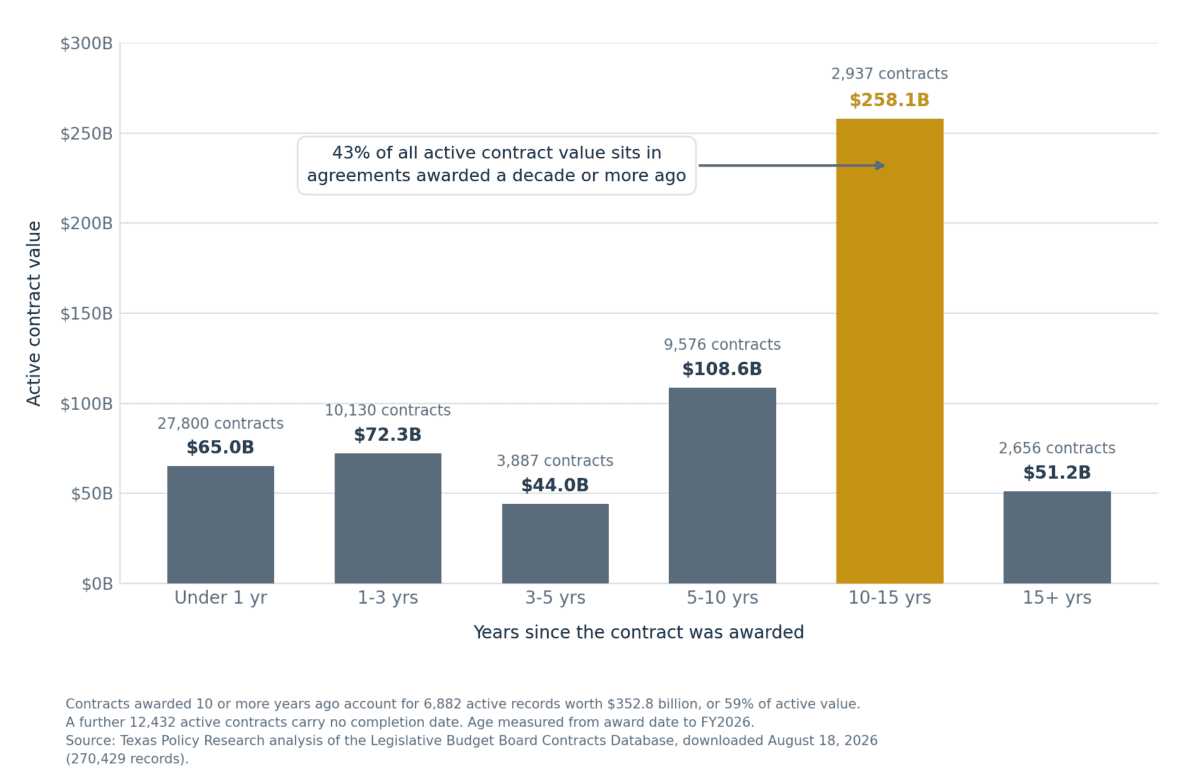
Of the $599.22 billion in active contract value, approximately $258.1 billion, roughly 43 percent, sits in agreements awarded between 10 and 15 years ago. Extend the window and 6,882 active contracts awarded a decade or more ago account for approximately $352.8 billion, about 59 percent of all active value.
Eight of the ten largest contracts in the database share a single award date: September 1, 2011. All remain active. The largest among them, a managed-care agreement worth approximately $42.07 billion, has been open for fifteen years. In total, 86 active contracts carry that 2011 award date and together account for roughly $234.6 billion. A further 12,432 active contracts carry no completion date at all.
Long-term managed-care arrangements, multi-year construction programs, and open-ended service agreements are ordinary features of state government. A long contract is not a bad contract. But this relocates the oversight question. The state's exposure is not concentrated in what Texas is buying this year. It is concentrated in agreements that have been amended, renewed, and extended well past the point at which anyone reviewed the original competition.
How Often Texas Skips Competition Has Changed
Of the more than 270,000 records in the current LBB download, approximately 37.7 percent fall into one of the database's noncompetitive procurement categories.
"Noncompetitive" does not automatically mean improper or wasteful. The category includes provider enrollment, interagency agreements, emergency procurements, federally mandated contracts, direct awards, and other circumstances where ordinary competitive bidding may not be possible or appropriate. The dollar figures tell a somewhat different story than the contract count: competitive contracts account for approximately three-quarters of all reported value, noncompetitive categories for roughly one-quarter.
A single snapshot obscures the more useful fact, which is that the exception rate has moved.
Noncompetitive Awards Rose From Near a Third to Over 40 Percent
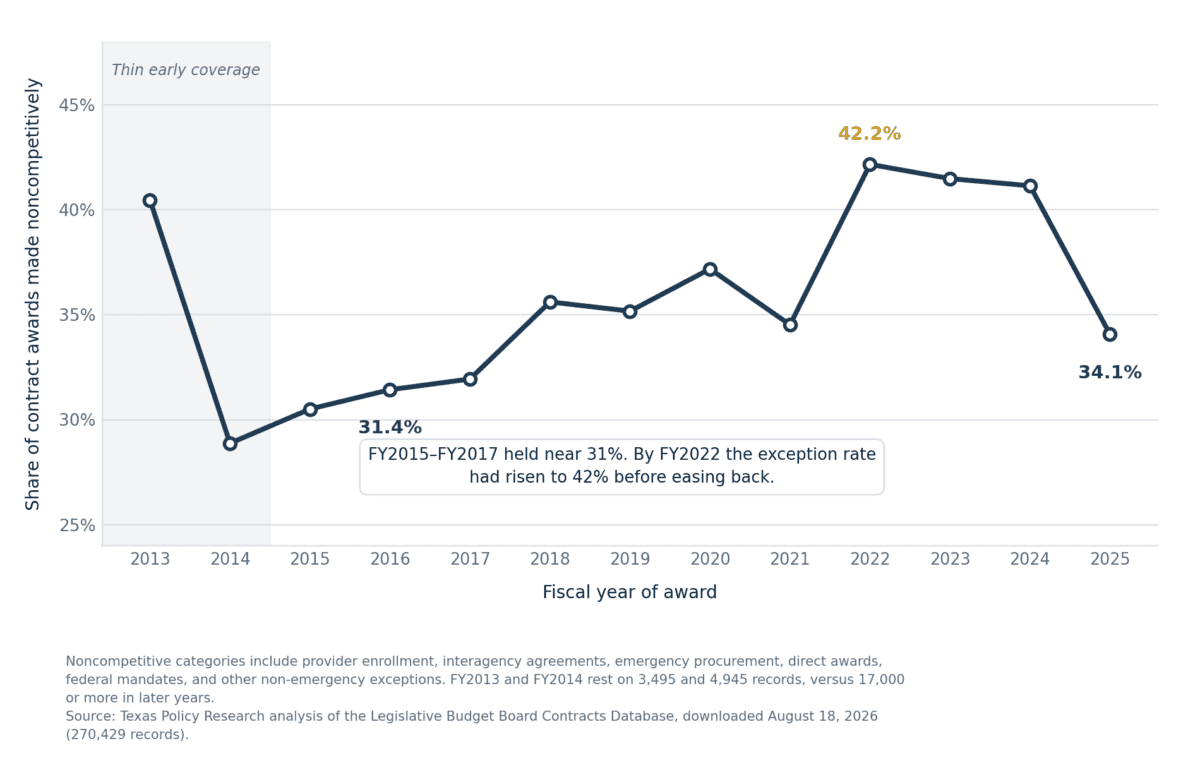
From FY2015 through FY2017, noncompetitive awards held near 31 percent of contract records. By FY2022, that share had risen to approximately 42 percent, and it remained above 41 percent through FY2024 before easing to approximately 34 percent in FY2025. An exception rate that moves ten points in six years and then partially retreats is a reason to ask what changed, in agency practice, in statutory authority, or in reporting convention.
One category within that total moved far more sharply.
Emergency Procurement Surged and Never Came Back Down
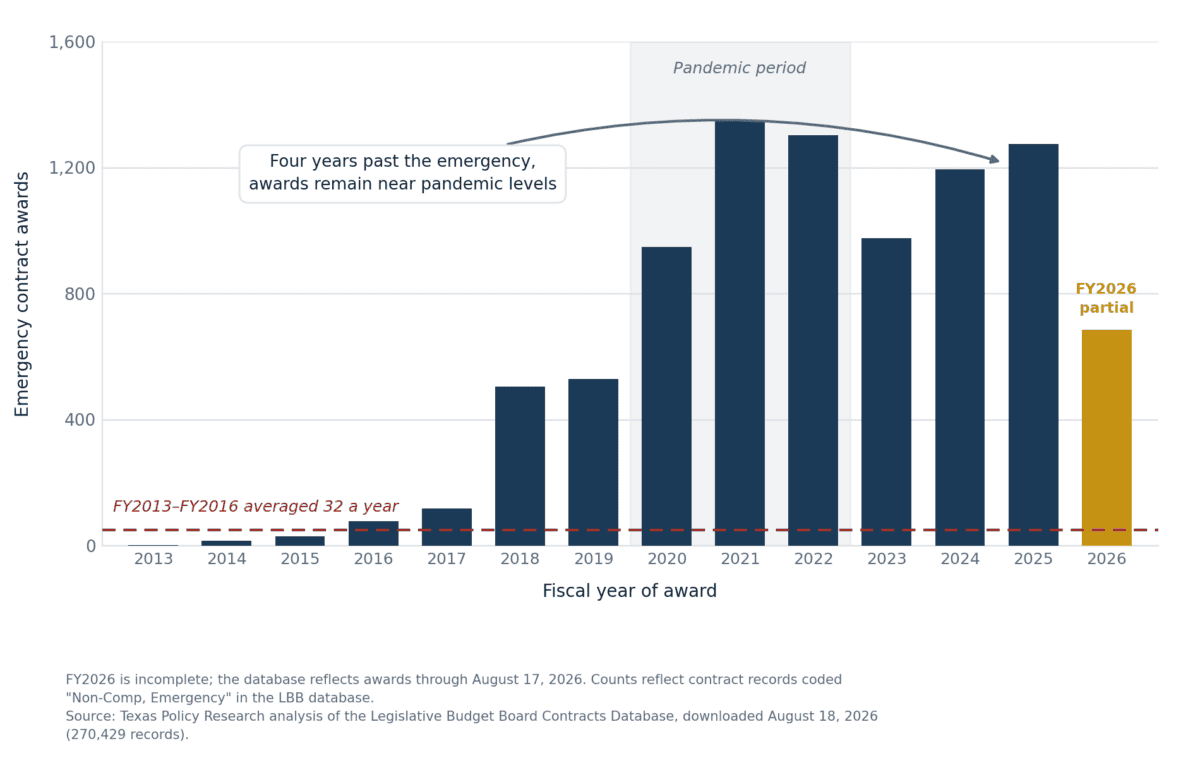
From FY2013 through FY2016, Texas agencies reported an average of 32 emergency contract awards per year. Beginning in FY2018, the number climbed sharply, reaching 1,349 in FY2021 at the height of the pandemic. It has not returned to anything close to its prior baseline. Texas recorded 1,195 emergency awards in FY2024 and 1,275 in FY2025, four years past the emergency that occasioned the increase, and still roughly forty times the pre-2018 average.
Some of that growth reflects genuine expansion in the scale of state contracting, and some may reflect changes in how agencies classify awards. But emergency procurement authority exists precisely because it sets aside protections that ordinarily apply. When an exception used a few dozen times a year becomes an exception used more than a thousand times a year and stays there, it has become a routine practice operating without the safeguards that attach to routine practice.
That is a discrete question the Legislature can answer: whether emergency procurement authority as it now operates still matches the circumstances it was written for, and whether continued use at this volume should require periodic re-justification.
The State Cannot Easily Total What It Owes a Single Company
Texas can tell you what it has contracted with an agency. It has a much harder time telling you what it has contracted with a company.
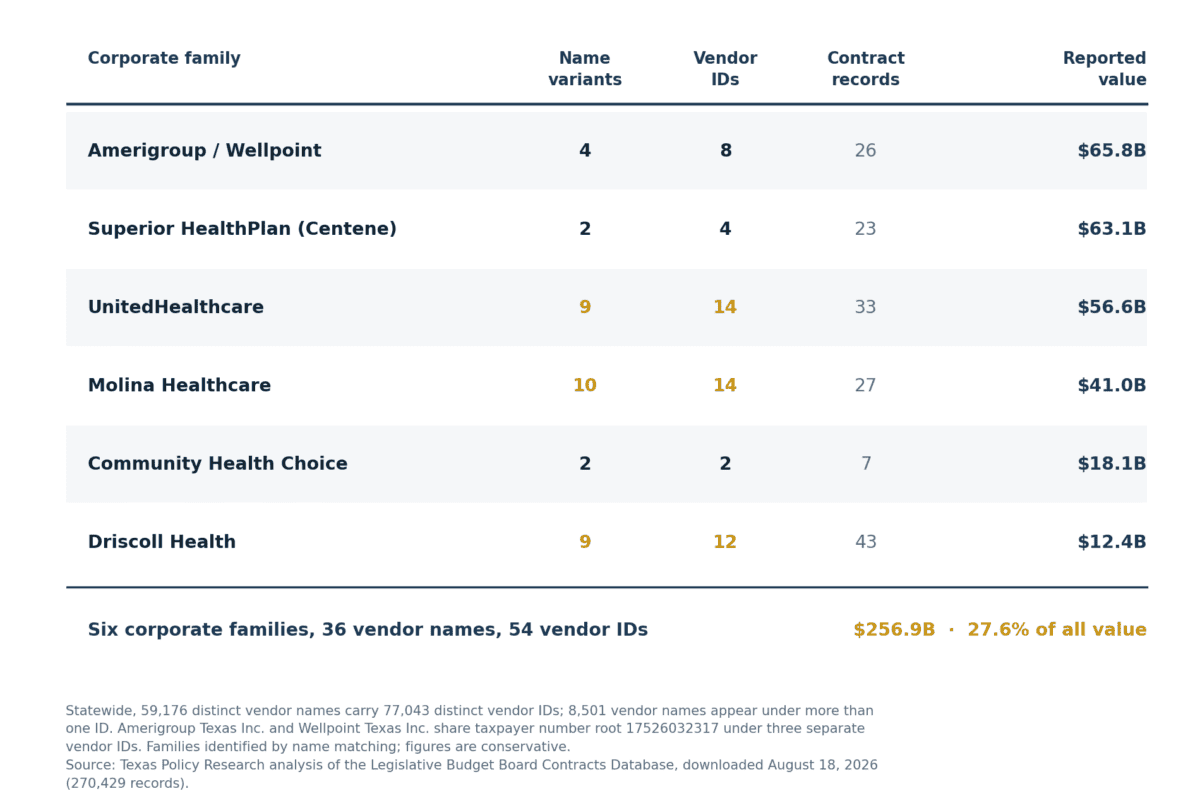
The ten largest vendors by name in the LBB database account for approximately 29.6 percent of all reported contract value, and the top 25 account for approximately 42.7 percent. Those figures understate actual concentration, because the same corporate entity appears under multiple names and multiple identifiers.
Statewide, 59,176 distinct vendor names carry 77,043 distinct vendor IDs. More than 8,500 vendor names appear under more than one identifier. The University of Texas at Austin alone appears under 88 separate vendor IDs, and then again, under a slightly different spelling of its name, under 48 more.
The pattern is clearest among the state's largest contractors. Amerigroup Texas Inc. and Wellpoint Texas Inc. appear as separate vendors under separate identifiers but share the same eleven-digit taxpayer number root. Six managed-care corporate families appear under 36 distinct vendor names and 54 distinct vendor IDs, together accounting for approximately $256.9 billion, or 27.6 percent of all reported contract value.
This is a plumbing problem, and Texas can fix it without creating anything new. But it is not a harmless one, because the state has already built a system that depends on getting vendor identity right.
The Comptroller's Statewide Procurement Division maintains the Vendor Performance Tracking System. State agencies are required to use VPTS to determine whether to award a contract to a vendor based on past performance, including review of published vendor performance reports. Agencies must report vendor performance for any purchase of goods or services exceeding $25,000, at key milestones when a contract exceeds $5 million, and at least once a year during the term of the contract. Vendors receive letter grades from A to F across five measurable categories. Grades of D and F trigger a vendor response window and a protest process. The Comptroller separately maintains a Debarred Vendor List.
That system grades vendors by identity. When a single corporate family operates under three dozen names and more than fifty identifiers, performance history does not aggregate. An agency conducting the past-performance review that statute requires may be looking at a vendor name carrying no record at all, while the same parent company's history sits elsewhere in the system under a different identifier. A poor grade earned under one name does not necessarily follow the company to its next award under another.
Nothing in the data shows that has happened. But the state should not have to hope it hasn't. Requiring a consistent entity identifier is a reporting-standard fix, and it is the precondition for the vendor performance system Texas has already built and already requires agencies to consult.
The Oversight System Texas Already Built
None of this means Texas has ignored contract oversight. The existing framework is fairly extensive.
State agencies generally must report contracts exceeding $50,000 to the LBB. Certain noncompetitive contracts exceeding $1 million and competitive contracts exceeding $10 million face additional reporting requirements. Amendments or renewals to contracts over $1 million must also be reported when their value increases by 10 percent or more. Other requirements cover long-running contracts, extensions, consulting agreements, and compliance with Contract Advisory Team recommendations.
The LBB's Contracts Oversight Team sits near the center of that system. It maintains the public Contracts Database, reviews contracts exceeding $1 million, compiles quarterly reports on contracts that increase in value by at least 10 percent, publishes annual information about agency compliance with procurement rules, and provides assistance to legislators. The LBB also has statutory and budgetary authority to conduct risk assessments and detailed reviews of higher-risk contracts.
Nor is the LBB operating alone. The 2026–27 state budget includes $234.1 million for independent Offices of Inspector General at HHSC, the Texas Juvenile Justice Department (TJJD), and the Department of Public Safety (TxDPS). The Office of the Attorney General (OAG) received another $49.8 million for Medicaid benefit oversight. Major audit functions at the Comptroller and State Auditor's Office (SAO) received $296.1 million, while major fiscal oversight functions at the Comptroller and LBB received another $89.9 million. The LBB appropriately notes that those broader audit and fiscal functions are not exclusively dedicated to combating fraud, waste, and abuse.
The obvious policy response to weaknesses in government oversight is to create another office, mandate another report, or appropriate more money. The LBB's own presentation suggests Texas should first ask a different question. Are taxpayers getting everything they should from the oversight infrastructure they already fund?
Oversight Should Follow the Risk
A recent Texas Policy Research (TPR) analysis demonstrates what the existing data can do. Looking at more than 235,000 records representing over $510 billion in reported value across fiscal years 2013 through 2025, a relatively simple variance analysis identified individual records whose reported contract values differed by three or more orders of magnitude from previous agreements by the same agencies for the same services.
An unusual value might reflect a reporting error, a legitimate change in scope, or a reporting convention not obvious from the public database. The LBB itself cautions that contract information originates with reporting agencies and should not be treated as an independently audited set of financial statements. But comparing a new contract against an agency's previous agreements for the same service does not require a sophisticated artificial intelligence system. A scheduled query can flag an unusually large change for human review. That analysis required no new statutory authority and relied entirely on publicly available information.
The harder question is who would run such a screen, and Texas does not need to build new institutions to answer it.
The Oversight Bodies Already Exist
Under Section 301.014 of the Government Code, every House standing committee carries broad oversight responsibility over the agencies within its jurisdiction. Speaker Dustin Burrows leaned hard on that authority in the 2026 interim charges, directing nearly every committee to monitor its agencies for fraud, waste, and abuse. Rather than centralizing the question in one committee, the House distributed it across the chamber. One consequence is that no single body currently owns the cross-agency view this data provides.
Several bodies sit closer to the center of the contracting question.
The House Committee on Delivery of Government Efficiency, chaired by State Rep. Giovanni Capriglione (R-Southlake), holds the most directly relevant charge: to study how the state can leverage technology, including artificial intelligence, to detect fraud, waste, and abuse of taxpayer resources. The committee took up that charge on Wednesday.
The Senate Finance Committee received a parallel charge from Lieutenant Governor Dan Patrick (R), framed more specifically. The committee was directed to review agency strategies for detecting fraud, waste, and abuse, quantify the fiscal impact of financial impropriety, and identify high-risk areas, naming contracted services and technology contracts explicitly. When it heard that charge in July 2026, much of the discussion centered on Medicaid, unsurprising given that Medicaid and managed care dominate the dollar figures in the LBB database.
The House Select Committee on Governmental Oversight, created in March 2026 and chaired by State Rep. Cody Vasut (R-Angleton), is a thirteen-member panel with broad jurisdiction over the accountability and integrity of state government and political subdivisions. Its seven interim charges lean toward governance, compliance with state and federal law, the Texas Regulatory Consistency Act, public information and open meetings law, and whether jurisdictional boundaries between state and local government are appropriately drawn. Procurement is not its central assignment, but a committee organized around whether government operates with integrity has an obvious interest in whether the state can account for what it has obligated and to whom.
The Sunset Advisory Commission has the most leverage over the specific problem this data describes. Roughly 130 entities are subject to Sunset review, with 20 to 30 moving through each cycle. During the 2024–25 cycle, the Commission reviewed twelve entities and produced more than $135.4 million in projected five-year savings. Since 1977, the process has abolished 42 agencies and consolidated another 54, and the Legislature typically adopts about 80 percent of its recommendations.
The timing matters. HHSC, the agency accounting for roughly 57 percent of all reported contract value, is under full Sunset review in the 2026–27 cycle, subject to abolishment, as required by Senate Bill 200 (SB 200) from the 84th Legislature. The Commission's report to the 90th Legislature is expected in February 2027.
The Contract Advisory Team, established under Chapter 2262 of the Government Code, sits at the operational layer. Its five members review solicitation and contract documents for agency contracts valued at $5 million or more and review State Auditor findings regarding agency compliance with the statewide contract management guide. Chapter 2262 also directs the Comptroller to maintain the vendor performance tracking system described above.
Where Risk Actually Sits
The largest contracts are the obvious starting point. When fewer than 100 records represent nearly half of the reported value in a database of more than 270,000, those agreements warrant continuous monitoring rather than periodic review, and the same holds for agencies whose contracting portfolios dwarf those of most state entities. The oldest agreements deserve comparable attention, since roughly 59 percent of active dollar exposure sits in contracts awarded a decade or more ago.
Dollar value is not the only signal, though. A smaller contract might warrant scrutiny because its value increased dramatically, because the same vendor repeatedly receives noncompetitive awards, because amendments substantially exceed the original award, because emergency authority is invoked routinely rather than exceptionally, or because an agency's procurement patterns differ sharply from those of comparable entities.
Texas already recognizes a version of this. The LBB reviews contracts exceeding $1 million and tracks significant increases in value. The Contract Advisory Team reviews solicitations above $5 million. Both are threshold-based, both are largely document-driven, and neither runs continuously against the full database.
What Each Body Could Do
The Delivery of Government Efficiency Committee is the natural home for automated exception screening. Its charge is technology applied to fraud, waste, and abuse detection, and the LBB database is the largest ready-made test case in state government. The committee could recommend that the LBB, SAO, and agency inspectors general run routine automated checks against data Texas already collects, screening for unusual changes in value, significant deviations from previous awards, duplicate records, repeated noncompetitive procurement, and amendments that materially increase an agreement's original value.
The Sunset Advisory Commission's HHSC review is the place to examine contract management at the agency holding the majority of the state's exposure: how it monitors long-running managed-care agreements, how it tracks amendments, and whether its reporting reflects the real structure of its vendor relationships.
The Contract Advisory Team and the Comptroller are positioned to resolve vendor identity within existing Chapter 2262 authority.
Senate Finance, having named contracted services as a high-risk area, can ask the budget question: whether the hundreds of millions already appropriated to inspectors general, audit, and fiscal oversight are deployed against the concentrations the data actually shows.
The Select Committee on Governmental Oversight could take up transparency, whether the public database gives Texans a usable picture of what their government has obligated, and whether current reporting thresholds still produce meaningful disclosure.
Results should be published periodically, so lawmakers, journalists, researchers, and taxpayers can see what was flagged and how agencies resolved it. Lawmakers should also reconsider how success is measured. Audits completed and dollars recovered after the fact tell only part of the story. Preventing an improper payment is better than recovering one.
Auditing Government Is Not Surveilling Citizens
Texas Policy Research (TPR) has spent considerable effort documenting how government use of automated systems threatens the privacy of Texans. It is worth being precise about what is and is not being proposed here.
The distinction is the direction the technology points. Automated license plate readers, geofence warrants, and connected-vehicle telematics turn government analytical capacity outward, toward people who are not suspected of anything. What is described here points the same capacity inward, at the government's own transactions: contracts the state itself entered into, using data agencies are already required to report, about the expenditure of public money. Applying scrutiny to the government's own financial conduct is accountability, not surveillance.
That line has to hold in practice. Fraud prevention should not become a justification for building centralized surveillance systems or collecting information unrelated to legitimate governmental purposes. A system that begins with contract screening and expands into monitoring the private conduct of citizens, vendors' employees, or program beneficiaries has crossed from accountability into something else. Technology should make government more accountable to Texans, not Texans more observable to government.
Within that boundary, artificial intelligence can strengthen this work considerably. AI is well suited to finding patterns across enormous datasets. Procurement records, payment histories, contract amendments, vendor relationships, grants, and invoices can be examined far faster by automated systems than by individual auditors. Texas is not starting from zero; the LBB notes that agencies already use general appropriations for functions including internal audits, utilization reviews, cybersecurity, and data analytics.
An automated system might determine that a contract is dramatically more expensive than comparable agreements, that a vendor's share of an agency's contracts has increased unusually quickly, that amendments have pushed an agreement far beyond its original value, or that several apparently distinct vendors resolve to a single corporate parent. The appropriate result is a flag for human review.
But lawmakers should resist treating an algorithm as auditor, investigator, and judge. An algorithmic finding should not by itself establish fraud, terminate a contract, deny a benefit, impose a penalty, or trigger adverse government action. Meaningful human review and due process must remain between an automated finding and the exercise of government power.
The Window Is Narrow
Fraud is only one way taxpayers lose money. Government can spend every dollar legally and still spend it poorly. The LBB's own July presentation noted that Texas lacks a single statutory definition of fraud, waste, and abuse, and described waste broadly as needless or careless expenditures resulting from deficient practices, systems, controls, or decisions. Obsolete programs, duplicative reporting requirements, and administrative inefficiency consume taxpayer resources without anyone committing a crime. Technology can tell lawmakers where to look. It cannot make the policy decision for them.
What makes this interim unusual is how much converges in a short span. The Delivery of Government Efficiency Committee is actively studying technology applied to fraud detection. Senate Finance has named contracted services as a high-risk area. The Sunset Advisory Commission is conducting a full review of the state's largest contracting agency, with its report due to the Legislature in February 2027. The 90th Legislature convenes January 12, 2027.
Texas has already built most of the machinery. It requires extensive reporting, maintains a public contracts database, grades vendor performance, employs inspectors general, and appropriates hundreds of millions of dollars to audit and oversight functions. What it has not done is point that machinery at the places where taxpayer exposure is actually concentrated: the small number of very large agreements, the decade-old contracts carrying the majority of active value, the exception categories that have quietly become routine, and the vendor records the state cannot reliably total.
Texas Policy Research Action has recommended that lawmakers direct existing oversight entities to conduct routine automated exception screening, establish human-review and due-process standards for AI-generated findings, and measure oversight performance based on waste prevented and errors corrected rather than activities undertaken.
The opportunity for the 90th Legislature is not to build more machinery. It is to make the machinery Texas already has work better.
Methodology
This analysis draws on the Legislative Budget Board Contracts Database, downloaded August 18, 2026. The download contains 270,429 contract records from 190 state agencies and institutions, with award dates ranging from November 1962 through August 17, 2026.
Reported values reflect current contract value as reported by state agencies, not expenditures. Contract values were parsed from the database's currency-formatted value field; award dates were assigned to state fiscal years beginning September 1. Fiscal year 2026 is incomplete. FY2013 and FY2014 rest on 3,495 and 4,945 records respectively, compared with 17,000 or more in later years, and early-period trend figures should be read with that in mind.
Corporate-family groupings in the vendor analysis were identified by name matching against the database's vendor name field and are conservative; actual concentration is likely higher. Contract information originates with reporting state agencies and institutions and is not independently audited.
The underlying data is publicly available from the LBB. Texas Policy Research's working files are available on request.
Support Our Work
Texas Policy Research relies on generous donors across Texas. If you found this helpful, please consider supporting our efforts.
Donate TodayStay in the Loop
Subscribe for occasional emails with new research, event details, and ways to engage with Texas policy.
Subscribe for Updates
