


Estimated Time to Read: 20 minutes
Editor's Note: Following the Senate Business and Commerce Committee's July 30 hearing, Chairman Charles Schwertner (R-Georgetown) called on the Public Utility Commission of Texas (PUC) to deny the pending Certificate of Convenience and Necessity (CCN) applications for the proposed 765-kV transmission lines, citing widespread concerns raised by landowners regarding notice, due process, and the current approval process. Lt. Gov. Dan Patrick (R) subsequently endorsed that position, stating that while Texas needs additional transmission infrastructure to support continued growth, the current CCN process is "broken" and should be reformed before the projects move forward. Their statements reinforce one of the hearing's central themes: the debate has shifted from whether Texas needs additional transmission to whether the process used to approve these projects adequately protects private property rights.
As Texas continues to experience rapid population growth, industrial expansion, and unprecedented electricity demand, state policymakers face an increasingly difficult challenge: how can the state continue building the electric infrastructure needed to support economic growth while preserving the private property rights that have long defined Texas?
That question dominated a Wednesday interim hearing before the Texas Senate Committee on Business and Commerce, where lawmakers spent hours examining the pending 765-kV CCN applications for proposed transmission lines and its potential impacts on landowners, communities, businesses, and the state's electric grid. The committee's interim charge directed senators to determine whether Texas' current planning, permitting, and siting process appropriately balances future infrastructure needs with protections for private property, long-term land use, and local communities.
The hearing marked one of the Legislature's most comprehensive examinations of the proposal since ERCOT and the Public Utility Commission of Texas (PUC) began advancing what has become one of the largest transmission initiatives in state history. Over the course of the day, Senators heard testimony from state regulators, electric utilities, transmission providers, business organizations, policy experts, landowners, attorneys, and rural property owners, reflecting nearly every major perspective in the debate.
Our previous coverage in June examined whether Texas needed a new statewide 765-kV transmission backbone and explored the emerging disagreements surrounding ERCOT's planning assumptions. Wednesday's hearing showed that the conversation has evolved considerably. Rather than debating only whether the transmission lines should be built, lawmakers are now asking broader questions about future demand, data centers, dispatchable generation, legislative oversight, and whether projects of this scale deserve additional scrutiny before moving forward.
How Texas Got Here
The July 29 hearing did not occur in isolation. It came after several years of rapidly growing electricity demand projections, increasing interest in artificial intelligence (AI) infrastructure, and legislative efforts to modernize how Texas plans for large electric customers. Together, those developments have reshaped the state's conversation about transmission planning and electric reliability.
One of the primary drivers has been the unprecedented number of large-load interconnection requests submitted to ERCOT. Those requests include a wide range of industrial facilities, but the overwhelming majority of projected demand currently comes from proposed data centers supporting cloud computing and AI. While not every project will ultimately be built, the sheer volume of requests has prompted regulators and lawmakers to reevaluate how Texas plans for future infrastructure.
In response, the Texas Legislature passed Senate Bill 6 (SB 6) during the 89th Regular Session (2025). The legislation establishes a new framework for planning and interconnecting large electric loads within ERCOT while directing the PUC to develop standards intended to minimize stranded infrastructure costs, improve forecasting, protect grid reliability, and ensure large-load customers contribute appropriately to the costs of serving their demand. The bill also requires additional planning for transmission cost allocation, financial commitments from large-load customers, and reliability measures designed to reduce risks associated with speculative interconnection requests.
Importantly, the proposed 765-kV transmission network predates the recent surge in AI-related data center development. Although today's large-load forecasts have intensified discussion around transmission planning, ERCOT has evaluated extra-high-voltage transmission for years as part of broader efforts to strengthen the transmission backbone connecting West Texas generation resources with the rest of the ERCOT grid and accommodate long-term statewide growth. While the growth in large-load requests has added new urgency to those discussions, lawmakers generally treated the hearing as part of a broader debate over how Texas should build and finance infrastructure capable of supporting decades of continued economic growth. The hearing reflected growing legislative interest in how ERCOT develops long-range transmission plans and balances reliability objectives against concerns over cost, forecasting uncertainty, and private property rights.
Why 765-kV?
The current debate began with House Bill 5066 (HB 5066), enacted during the 88th Legislature (2023) and authored by State Rep. Charlie Geren (R-Fort Worth), which directed the PUC and ERCOT to develop a reliability plan for the Permian Basin. The legislation responded to concerns that growing oil and gas production, industrial development, and other large electric users would eventually require additional infrastructure to maintain reliable electric service.
ERCOT's subsequent studies concluded that while local transmission improvements could address projected demand over the near term, additional regional transmission capacity would eventually be necessary to move electricity into West Texas. As planners expanded their analysis beyond the Permian Basin, those recommendations ultimately evolved into a broader Strategic Transmission Expansion Plan (STEP) incorporating multiple proposed 765-kV transmission corridors across Texas.
Although data centers featured prominently during the hearing, ERCOT emphasized that the proposed 765-kV network is intended as a long-term transmission backbone rather than infrastructure dedicated to any single customer class or industry. The proposal is designed to improve the movement of electricity across the ERCOT system, connect growing generation resources in West Texas with demand elsewhere in the state, and provide capacity for future growth regardless of which industries ultimately drive that demand.
According to ERCOT, extra-high-voltage transmission provides several advantages over constructing multiple lower-voltage corridors. Agency officials argue that higher-voltage infrastructure can transfer significantly more electricity over longer distances, reduce transmission losses, improve operational flexibility, accommodate future uncertainty in where generation is built, and reduce the total amount of right-of-way required compared to constructing several lower-voltage lines capable of carrying the same amount of power.
Opponents, however, argue that the proposal has grown far beyond what lawmakers contemplated when HB 5066 became law. While they generally acknowledge that additional electric infrastructure will be necessary, they contend the legislation authorized a reliability study for the Permian Basin, not the development of a statewide transmission backbone carrying tens of billions of dollars in long-term costs. The Texas Public Policy Foundation's (TPPF) recent study concludes that lawmakers should pause implementation, reevaluate alternatives, and determine whether different combinations of transmission and dispatchable generation could achieve comparable reliability outcomes with fewer costs and less impact on private property.
Those competing perspectives framed much of Wednesday's discussion.
ERCOT's Demand Forecast
Perhaps the hearing's most significant takeaway was ERCOT's message that Texas has entered a fundamentally different era of electricity planning. While Texas has experienced sustained population and economic growth for decades, ERCOT officials argued that the scale and uncertainty of today's large-load requests require planners to think further into the future than ever before.
Much of that discussion centered on large-load interconnection requests, many of which are associated with proposed data centers supporting artificial intelligence and cloud computing. Although data centers have become the focal point of many recent policy debates, committee members largely focused less on whether Texas should welcome those investments and more on ensuring the state's planning framework appropriately balances economic growth, electric reliability, cost responsibility, and long-term infrastructure needs.
The hearing also highlighted the ongoing implementation of SB 6. Many of the issues discussed by lawmakers, including large-load forecasting, interconnection standards, transmission cost allocation, financial commitments, and the development of ERCOT's Batch Zero process, stem directly from the regulatory framework established by the Legislature during the 89th Regular Session (2025).
ERCOT President and CEO Pablo Vegas and Senior Vice President Woody Rickerson described a grid experiencing unprecedented demand growth driven by population increases, industrial expansion, electrification, manufacturing, and especially large-load customers. While the electric system has continued operating reliably during recent periods of record demand, ERCOT argued that planning decisions must account for where Texas is expected to be several years from now rather than where it stands today.
The statistic that received the greatest attention involved large-load interconnection requests. ERCOT reported that it is currently tracking approximately 474 gigawatts of proposed large electric loads statewide, with roughly 90 percent associated with data centers. Although many of those projects are unlikely to be constructed, ERCOT argued that the sheer volume of proposed development represents a fundamental shift in how the state must approach long-term transmission planning.
Large Load Interconnection Requests (as of June 2026)
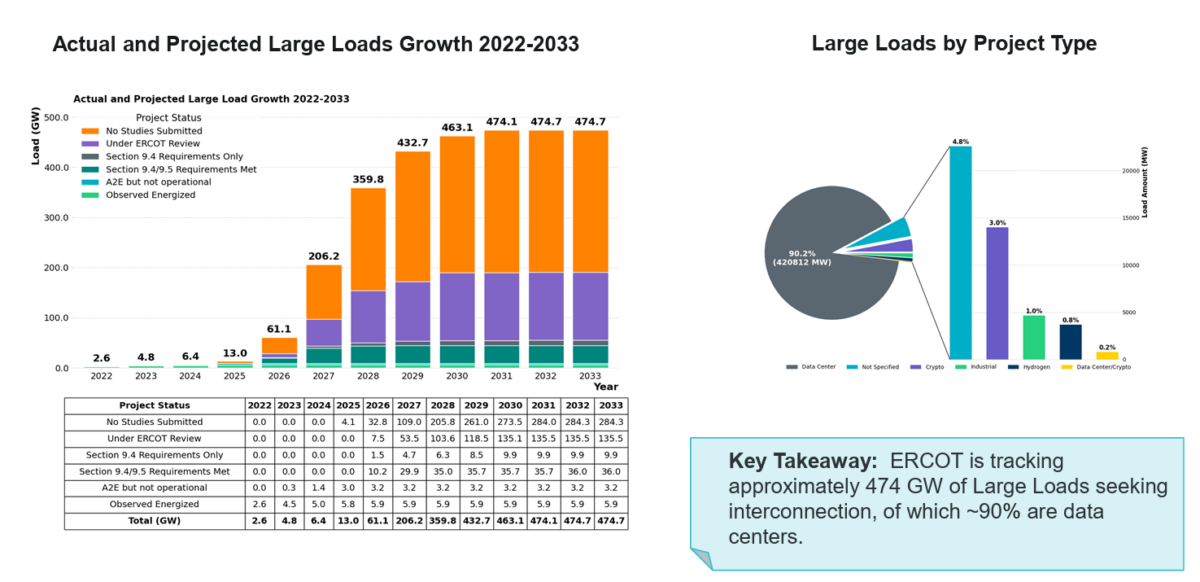
Committee members repeatedly distinguished between today's interconnection requests and the long-term transmission network under discussion. ERCOT acknowledged that not every proposed project will ultimately be constructed, and many requests are expected to fall away over time. Rather than planning transmission exclusively for data centers, the discussion focused on how Texas should prepare for an uncertain future while maintaining reliability, avoiding unnecessary costs, and preserving flexibility as economic conditions evolve.
At the same time, ERCOT acknowledged that not every proposed project will ultimately connect to the grid. Through its new Batch Zero interconnection process, ERCOT is evaluating which projects have demonstrated sufficient progress to warrant continued planning. Preliminary figures presented during the hearing showed that only about 205 gigawatts of proposed large loads currently qualify for inclusion in Batch Zero, while hundreds of gigawatts of additional requests either lack qualifying studies or failed to satisfy other eligibility requirements. Final determinations are expected by August 7 before being communicated to developers in early September.
That distinction became one of the hearing's central policy questions. Supporters of expanded transmission argued Texas should prepare for future growth before reliability problems emerge. Critics questioned how much infrastructure should be financed based upon demand projections that remain uncertain.
More Than Transmission
One of the hearing's clearest messages was that the debate has expanded well beyond transmission lines themselves.
Nearly every invited witness agreed Texas will require significant investment in electric infrastructure as the state's economy continues growing. The disagreement instead centered on how Texas should meet that demand and what assumptions should guide long-term planning.
ERCOT's testimony focused primarily on reliability and system planning. Agency officials argued that transmission infrastructure often requires many years to permit, design, and construct, making it necessary to begin planning well before projected demand materializes. From ERCOT's perspective, waiting until transmission constraints develop risks higher costs, slower economic development, and greater reliability challenges in the future.
Transmission providers, electric utilities, and several industry organizations echoed that position. One coalition supporting the proposal, Texans for Responsible Infrastructure Investment (TRII), has likewise argued that long-term infrastructure planning is necessary to support continued investment across Texas and that higher-capacity transmission corridors can ultimately reduce congestion, improve reliability, and require fewer cumulative transmission corridors than multiple lower-voltage alternatives serving equivalent demand.
The TPPF presented a different vision. Brent Bennett, Ph.D., the Policy Director at Life: Powered at TPPF, argued the central question is not whether Texas needs additional infrastructure, but whether long-distance transmission should precede the development of additional dispatchable generation. The Foundation's analysis concludes that Texas should first pursue market reforms and encourage more reliable generation closer to growing demand centers before committing to one of the largest transmission buildouts in state history.
Opponents of the current proposal also questioned whether ERCOT's planning assumptions sufficiently considered alternative approaches. Several witnesses argued Texas should place greater emphasis on expanding dispatchable generation closer to growing demand centers before committing to a statewide transmission buildout of this scale. Others questioned whether long-term demand forecasts remain sufficiently certain to justify infrastructure investments of this magnitude, particularly as ERCOT continues refining its projections for large industrial users and data centers.
Ultimately, the hearing demonstrated that the debate extends well beyond the question of whether Texas should construct additional transmission lines. It encompasses broader questions about how the state forecasts future demand, allocates infrastructure costs, protects private property, maintains electric reliability, and preserves a competitive electricity market. While data centers and other large electric customers have accelerated these discussions, lawmakers appeared focused on developing policies capable of serving Texas' long-term interests regardless of how future demand ultimately develops.
Private Property Takes Center Stage
While the hearing covered a wide range of technical issues involving transmission planning, forecasting, and grid reliability, the committee's central focus repeatedly returned to private property rights.
That emphasis was evident in the interim charge itself. Rather than asking senators to determine whether Texas should build new transmission lines, the charge directed lawmakers to evaluate whether existing planning and regulatory processes sufficiently protect landowners while considering the effects of high-voltage transmission on property values, long-term land use, environmental factors, homes, businesses, and rural communities. It also asked the committee to consider whether Texas should improve its transmission planning, permitting, and siting process before additional infrastructure moves forward.
Landowners, ranchers, attorneys, and community representatives argued that projects of this magnitude carry consequences extending well beyond the compensation offered for transmission easements. Witnesses described concerns involving multigenerational family land, agricultural operations, future development opportunities, water infrastructure, and the cumulative impact of introducing hundreds of miles of new transmission corridors across rural Texas.
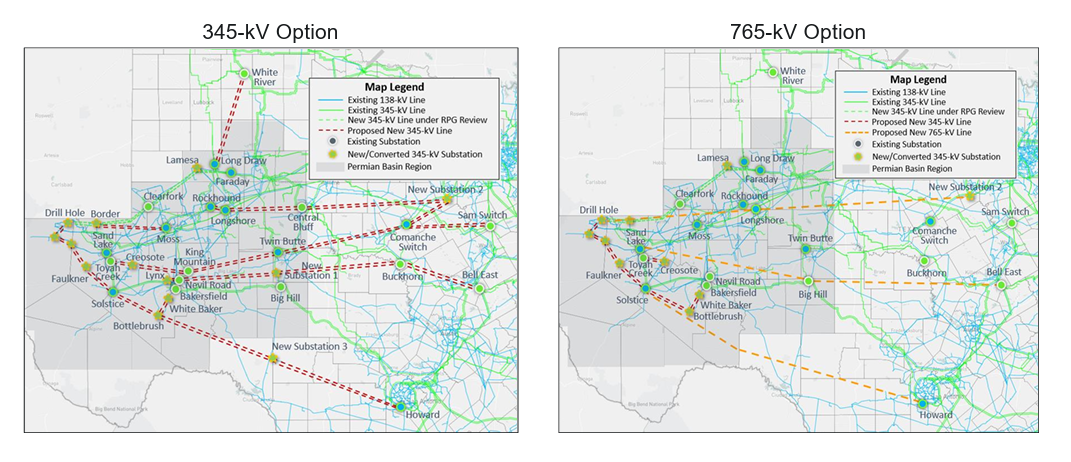
Supporters of the proposal responded that transmission easements generally allow continued agricultural use of the underlying property and argued that a smaller number of higher-capacity transmission corridors could ultimately reduce the total amount of land affected over time compared to constructing multiple lower-voltage lines. ERCOT similarly maintains that one 765-kV transmission corridor can transport the same amount of electricity as several 345-kV lines while requiring substantially less cumulative right-of-way over long distances.
Permian Basin Reliability Plan Comparison
Those concerns have also been echoed by members of the Legislature. In recent months, State Rep. Brad Buckley (R-Salado) has questioned whether the proposal has advanced more quickly than lawmakers anticipated when they approved HB 5066. Buckley has argued that Texas should place greater emphasis on expanding dispatchable generation before committing to a statewide transmission buildout of this scale, while also questioning whether ERCOT's planning assumptions rely too heavily on long-term demand projections and future renewable generation located far from growing load centers.
State Sen. Kevin Sparks (R-Midland), a member of the Senate Committee on Business and Commerce, has raised similar concerns. Representing much of the region directly affected by the proposal, Sparks has argued that lawmakers should have the opportunity to review ERCOT's evolving demand forecasts, alternative planning assumptions, and potential market reforms before additional transmission corridors receive final approval. Earlier this year, Buckley and Sparks jointly asked the PUC to pause portions of the project until after the 2027 legislative session, giving lawmakers an opportunity to more fully examine its long-term implications for ratepayers, rural communities, and private property owners before additional segments move forward.
Taken together, the hearing made clear that the debate is no longer simply about where transmission lines should be built. It has become a broader discussion about eminent domain, legislative oversight, due process, and how Texas balances statewide infrastructure needs with the rights of the landowners who stand to be most directly affected.
Those concerns have since been echoed by Senate leadership. On July 31, Chairman Charles Schwertner (R-Georgetown) publicly called on the PUC to deny the pending CCN applications, arguing that testimony presented during the hearing demonstrated the need for a complete overhaul of the state's transmission approval process before these projects advance. Lt. Gov. Dan Patrick (R) likewise endorsed denying the current applications, emphasizing that Texas can pursue needed transmission infrastructure while still reforming a process that better protects affected landowners and communities.
What's Next
Despite nearly a full day of testimony, Wednesday's hearing did not alter the project's immediate regulatory trajectory.
Instead, lawmakers used the hearing to better understand the competing assumptions underlying the proposal before making recommendations for the 90th Legislature.
In the near term, ERCOT will continue implementing its Batch Zero large-load interconnection process. Final eligibility determinations are expected by August 7, providing a clearer picture of which proposed large-load projects remain active under the initial planning framework. Those results will likely influence future transmission planning as ERCOT continues refining its long-term forecasts.
Meanwhile, the PUC continues considering individual Certificate of Convenience and Necessity applications for specific transmission segments. Those proceedings remain the primary venue where routes, engineering alternatives, environmental considerations, and landowner objections are evaluated before construction may proceed.
Although the Senate hearing itself carries no immediate regulatory authority, lawmakers now have a significantly more developed record upon which to base future policy recommendations. The committee did not consider legislation or vote on the proposed transmission network. Instead, the hearing served as an oversight opportunity for lawmakers to question ERCOT's planning assumptions, hear testimony from affected stakeholders, and evaluate whether future legislative action may be warranted.
Since the original publication of this article, Senate leadership has made clear that reforming the CCN process will be a priority during the 90th Legislature. Rather than rejecting additional transmission infrastructure outright, Chairman Schwertner and Lt. Gov. Patrick have instead argued that the pending applications should be denied until the approval process is reformed. That suggests the Legislature's focus in 2027 will likely center on improving notice requirements, due process protections, routing transparency, and other procedural safeguards before similar applications are reconsidered.
Looking Ahead
Although SB 6 established a new framework for planning and interconnecting large electric loads, Wednesday's hearing suggested lawmakers continue evaluating whether additional statutory or regulatory changes may be necessary as ERCOT refines its forecasting methods and long-term transmission planning. Several senators questioned how uncertainty should be incorporated into future planning models and whether additional safeguards are needed to ensure infrastructure investments remain cost-effective as projected demand evolves.
Many of the committee's questions ultimately centered on forecasting. Supporters argued that Texas must build infrastructure years before demand materializes, while critics questioned whether speculative projections could lead to unnecessary costs or infrastructure that exceeds future needs. The resulting debate was less about whether Texas should invest in transmission and more about how planners should balance uncertainty, reliability, and fiscal responsibility when making decisions that will shape the grid for decades to come.
The discussion also underscored that transmission planning has become increasingly intertwined with broader debates over AI, data centers, industrial growth, and Texas' long-term economic competitiveness. Rather than treating those issues as separate policy questions, lawmakers increasingly appear to view them as interconnected components of a broader conversation about how Texas can continue supporting economic growth while protecting consumers, ratepayers, and private property owners.
One recurring issue involved legislative oversight. Several witnesses questioned whether projects of statewide significance carrying multibillion-dollar costs and affecting thousands of landowners should continue advancing primarily through the existing regulatory process or whether the Legislature should play a more direct role before projects reach the permitting stage.
Lawmakers also appeared interested in whether ERCOT's long-term planning assumptions remain appropriate as Texas' electricity demand continues evolving. As data centers, artificial intelligence, industrial electrification, and manufacturing reshape the state's load forecasts, future legislative discussions are likely to examine how those forecasts should influence transmission planning and whether greater emphasis should be placed on encouraging dispatchable generation closer to major demand centers.
Another area likely to receive attention is the transmission siting process itself. Throughout the hearing, senators repeatedly returned to questions involving route selection, public participation, environmental impacts, and the extent to which existing Certificate of Convenience and Necessity proceedings provide meaningful opportunities for affected landowners to influence final routing decisions.
Finally, the hearing underscored that transmission policy cannot be considered in isolation. Discussions surrounding generation development, market design, large-load interconnections, cost allocation, and private property rights have become increasingly interconnected, suggesting the Legislature may ultimately pursue a broader review of Texas' electric planning framework rather than focusing solely on the proposed 765-kV corridors.
Those questions remain unanswered. However, Wednesday's hearing demonstrated that the debate has entered a new phase. Rather than asking whether Texas needs additional electric infrastructure, lawmakers are increasingly focused on ensuring that future infrastructure is planned transparently, built responsibly, and implemented in a manner that preserves both grid reliability and the private property rights that remain fundamental to Texas.
Conclusion
The Senate Business and Commerce Committee hearing demonstrated that Texas's debate over the proposed 765-kV transmission network extends well beyond engineering and electric reliability. While there appears to be broad agreement that Texas must continue investing in infrastructure to support a rapidly growing population and economy, lawmakers and stakeholders devoted much of the hearing to examining whether the current planning and approval process adequately protects the rights of affected landowners. Questions surrounding long-term demand forecasting, project costs, regulatory transparency, and private property rights emerged as central themes throughout the discussion.
The day after the hearing, those concerns were elevated beyond committee testimony and became the official position of Senate leadership. Chairman Charles Schwertner called on the Public Utility Commission to deny the pending Certificate of Convenience and Necessity (CCN) applications, concluding that the testimony presented during the hearing demonstrated the need for a comprehensive overhaul of Texas' transmission approval process before these projects move forward. Lt. Gov. Dan Patrick echoed that position, agreeing that while Texas needs additional transmission infrastructure to meet future electricity demand, support for the proposed 765-kV network should not come at the expense of private property rights or public confidence in the regulatory process.
These statements clarify that the immediate policy debate is no longer centered on whether Texas should expand its transmission system, but on whether the current CCN process is sufficiently transparent, predictable, and respectful of landowner rights. As the 90th Legislature convenes in January 2027, lawmakers are now expected to focus heavily on reforms to the state's transmission approval process, including issues such as landowner notification, routing transparency, due process protections, and the standards governing future CCN applications. Whatever the ultimate outcome of the proposed 765-kV network, the hearing and the subsequent statements from Senate leadership make clear that future transmission planning in Texas will likely require not only reliable infrastructure, but also a regulatory process that earns the trust of the Texans whose property and communities it affects.
More on Data Centers & The Grid
Every analysis, testimony, and commentary we've published on large loads, grid costs, and ratepayer risk.
Support Our Work
Texas Policy Research relies on generous donors across Texas. If you found this helpful, please consider supporting our efforts.
Donate TodayStay in the Loop
Subscribe for occasional emails with new research, event details, and ways to engage with Texas policy.
Subscribe for Updates
