


Estimated Time to Read: 25 minutes
The Texas Senate Committee on Local Government convened Tuesday to examine the effects of repeatedly increasing the residence homestead exemption, giving lawmakers an early preview of what may become one of the most consequential debates of the 90th Legislature.
The committee's chairman, State Sen. Paul Bettencourt (R-Houston), used the hearing to unveil what he described as the first comprehensive statewide collection of actual school district property tax bill data from all 254 Texas counties. The results showed substantial reductions in average school district property tax bills and a growing number of Texas homesteads paying no school district property taxes.
Those findings deserve recognition. Texas homeowners have received real property tax relief. They do not, however, establish that Texas has solved its property tax problem.
Some of the public messaging surrounding the hearing has blurred important distinctions among homeowners, homesteads, seniors, renters, individual tax bills, statewide averages, school district taxes, and total property taxes. Those distinctions matter as lawmakers consider expanding the homestead exemption again.
Bettencourt Unveils Texas Property Tax Data
Bettencourt’s office spent approximately four months collecting property tax information from county appraisal districts and county tax assessor-collectors. The committee requested 16 data points and compiled actual school district property tax bill information from across Texas.
The resulting presentation traced the growth of the school district residence homestead exemption from $15,000 in 2015 to $25,000, then $40,000, $100,000, and ultimately $140,000 in 2025. The combined exemption for homeowners who are over 65 or disabled now totals $200,000.
Texas voters overwhelmingly approved both constitutional amendments. TPR supported the general homestead increase through Proposition 13 with reservations, while opposing the larger age-based exemption established through Proposition 11.
Bettencourt told the committee that the current biennial state budget dedicates $51 billion to property tax relief. He also supplied an important breakdown that has received less attention than the exemption increases themselves. Approximately $38 billion supports school district maintenance and operations tax rate compression, while $13 billion supports homestead exemptions. That means nearly three-quarters of the state’s property tax relief commitment is associated with tax rate compression rather than exemptions.
The difference is critical when evaluating what produced the reported savings and which property tax relief strategy lawmakers should prioritize in the future.
TPR Supported Relief, but Not Every Exemption
Texas Policy Research (TPR) did not oppose the entire property tax relief package or deny that homeowners would benefit from lower school district tax bills.
During the 89th Legislative Session (2025), TPR recommended that lawmakers support Senate Bill 4 (SB 4) with amendments. The legislation implemented the increase in the general school district residence homestead exemption from $100,000 to $140,000. TPR concluded that the bill would allow homeowners to retain more of their income and strengthen their private property rights. At the same time, TPR urged lawmakers to amend the proposal by prioritizing broader school tax rate compression over additional exemption increases. When the accompanying constitutional amendment appeared on the November 2025 ballot as Proposition 13, TPR recommended that Texans vote yes, but with reservations. The immediate tax savings were real and worthwhile, but the exemption remained less equitable and less durable than compression.
TPR took a different position on Senate Bill 23 (SB 23) and Proposition 11, which increased the additional school district homestead exemption for over-65 and disabled homeowners from $10,000 to $60,000. TPR recommended voting no on both measures. The concern was not that elderly or disabled Texans should receive no relief. It was that an expanded age-based exemption would increase the state’s recurring fiscal obligation while concentrating benefits among one class of homeowners and leaving younger homeowners, renters, businesses, and other property owners outside the policy.
The Legislature could have used the same state resources to compress school M&O tax rates more broadly, delivering relief across the tax base and moving Texas closer to eliminating the tax.
These positions reflect the distinction at the center of the current debate. TPR supported immediate relief where it believed the benefits outweighed the concerns, but it consistently maintained that exemptions are not a substitute for spending restraint, universal rate compression, and property tax elimination.
Texas School Property Tax Bills Declined
The committee’s data showed that the average school district property tax bill for a general residence homestead declined from approximately $1,037 in 2024 to $896 in 2025. That represents an average reduction of $140.73, or 13.57 percent.
Among over-65 and disabled homesteads, the average school district property tax bill declined by $184.96, or 32.72 percent.
Kristin Bulanek, the Brazoria County tax assessor-collector and treasurer of the Texas Tax Assessor-Collectors Association, testified that the higher exemptions produced noticeable savings. Some property owners contacted her office because their bills were so much lower that they believed an error had occurred.
Boerne Independent School District Trustee Rich Sena presented local examples showing declining school district tax rates and lower tax bills despite rising market values.
State Sen. Bryan Hughes (R-Mineola), the committee's vice chairman, also noted that homeowners with escrow accounts may not immediately recognize the savings. Property taxes and homeowners insurance are frequently combined into one monthly mortgage payment. Rising insurance premiums can therefore conceal a property tax reduction.
These accounts reinforce that the Legislature delivered real relief. Texans who paid less in school property taxes benefited, even if other housing costs prevented them from seeing an equivalent reduction in their monthly mortgage payments. But the hearing’s statewide averages do not prove that every Texas homeowner received the same result.
Average Property Tax Savings Are Not Universal
Bettencourt’s official press release declared that “all” general homestead property tax bills were cut by 13.5 percent. During the hearing, he similarly pushed back against Texans who said they had not experienced a reduction.
The underlying data support a 13.57 percent reduction in the statewide average school district homestead tax bill. They do not demonstrate that every individual homestead received a 13.57 percent reduction or that every homeowner’s total property tax bill declined.
An average describes the overall dataset. It cannot establish the experience of every taxpayer within it. A homeowner could have benefited substantially from the larger exemption and compressed school tax rate while still paying more because of a higher appraisal, a voter-approved school tax increase, a growing debt service obligation, or higher taxes imposed by another local taxing unit.
The relevant comparison is not always whether a taxpayer’s final bill went down. It is also what the taxpayer paid compared with what would have been owed without the exemption and compression. That can show genuine savings even when the final tax bill increased. But lawmakers should describe that result as a reduction relative to the previous tax structure, not necessarily as a lower bill for every taxpayer.
The committee’s study provides compelling evidence of statewide school property tax relief. It should not be stretched beyond what the data actually measure.
Who Received Zero School Tax Bills?
The committee found that 39.23 percent of approximately 6.1 million Texas homestead properties paid no school district property taxes in 2025. Among properties receiving an over-65 or disabled homestead exemption, the share was 60.79 percent.
These are significant results, but the figures apply to qualifying homestead properties and only to school district property taxes. They do not include renters, businesses, second homes, or other non-homestead property. They also do not mean qualifying homeowners necessarily paid zero property taxes to cities, counties, or special-purpose districts.
The over-65 and disabled category does not encompass every senior Texan. It excludes seniors who rent, live with relatives, reside in assisted living facilities, or otherwise do not own a qualifying residence homestead. It also includes disabled homeowners who may be younger than 65.
That clarification made, the more important question is not whether the Legislature delivered savings to qualifying homeowners. The data show that it did. The question is who finances those savings and whether the policy reduces the overall cost of government.
Does the Homestead Exemption Shift the Burden?
Bettencourt pushed back against the argument that increasing the homestead exemption shifts school property taxes onto other property owners. His response was that the state replaces the revenue school districts would otherwise lose, effectively paying the exempted amount on homeowners’ behalf. That explanation is technically correct in one narrow sense. Because the state backfills the lost school district revenue, the remaining property owners within an individual district are not necessarily required to replace every exempted dollar through an immediate tax rate increase.
But describing the state as paying the tax does not resolve the burden-shifting question. It merely moves the discussion one level higher. The state has no money independent of taxpayers. The replacement funding comes from general revenue collected through sales taxes, severance taxes, franchise taxes, and other sources. Those taxes are paid directly or indirectly by homeowners, renters, consumers, and businesses, including taxpayers who cannot claim a residence homestead exemption.
The exemption therefore shifts the financing of government from qualifying homeowners’ local school tax bills to the broader state tax base. It does not make the cost disappear.
Renters help finance the state backfill through sales taxes while receiving no homestead exemption. Businesses pay franchise taxes, sales taxes, and property taxes on commercial property while helping finance relief limited primarily to owner-occupied homes. Younger Texans who have not yet purchased homes also contribute to the state revenue supporting exemptions for established homeowners.
The burden may not be shifted directly from one homeowner to the neighboring business on the same school district tax roll. But the financial obligation is transferred to a broader and differently composed group of taxpayers. That is still burden shifting.
Exemptions Reduce Bills, Not Spending
The more fundamental weakness of the homestead exemption is that it does not reduce the amount government spends.
School districts are held harmless. State appropriations grow to replace the exempted revenue. Qualifying homeowners receive lower bills, but the underlying government obligation remains intact. This is why the distinction between exemptions and compression matters.
An exemption changes which property value is taxed and requires the state to finance the resulting gap. Compression reduces the tax rate across the tax base and, when paired with spending restraint, can permanently shrink reliance on school property taxes.
Neither policy automatically reduces government spending. But compression provides broad relief and a measurable pathway toward a zero M&O rate. An exemption creates a recurring state obligation while excluding renters, businesses, and other non-homestead taxpayers from its direct benefits.
Each additional exemption also moves Texas further from uniform tax treatment by making liability depend increasingly on who owns the property and how it is used. As exemptions expand, so does the amount of school funding the state must replace. That obligation becomes especially concerning when lawmakers use temporary budget surpluses to make permanent constitutional promises.
The Semantic Dispute Obscures the Real Question
Whether the exemption produces an immediate rate increase for non-qualifying property owners is ultimately a secondary issue. The more important questions are whether total government spending declined, whether the overall tax burden declined, and whether every taxpayer moved closer to property tax elimination.
The answer to each is no.
Texas appropriated more state money to replace local school revenue. Renters and businesses continued paying property taxes without receiving a residence homestead exemption. Total statewide property tax levies reached $89.4 billion. The state assumed a larger recurring obligation that future taxpayers must maintain.
Bettencourt is therefore correct that the local school district does not simply send the exempted homeowner’s bill to another property owner. But it is incorrect to imply that no burden was transferred.
The bill was sent to the state. The state sent it to taxpayers.
That is the semantic dispute reduced to its substance.
Seniors Still Face Rising Property Taxes
Even qualifying seniors with zero-dollar school district tax bills are not insulated from the larger Texas property tax system.
The over-65 tax ceiling primarily applies to school district property taxes, which are generally the largest component of a property tax bill but not the only component. Cities, counties, community college districts, hospital districts, emergency services districts, and other local taxing units may continue imposing property taxes.
Seniors are also affected by property taxes embedded throughout the economy.
Businesses and commercial property owners incorporate property taxes into the cost of operating. Apartment owners account for them when setting rents. Retailers, service providers, healthcare facilities, and other businesses must recover those costs through the prices they charge.
A senior living on a fixed income may therefore receive a zero-dollar school district tax bill while still confronting higher local taxes, groceries, healthcare costs, rents, and other expenses affected by the broader property tax burden.
Rising property taxes can also reduce housing mobility. Seniors who want to downsize, move closer to family, or relocate for medical care may hesitate when moving introduces uncertainty about future taxes. Texas allows qualifying homeowners to transfer a percentage of their school district tax ceiling, but that protection does not extend uniformly across every taxing unit.
The result can be a lock-in effect that keeps seniors in homes that no longer meet their needs.
The idea that seniors no longer need to care about Texas property tax growth because many pay no school district tax is incomplete. The relevant question is not merely whether one portion of their tax bill is frozen. It is whether the larger system remains affordable and sustainable.
Lowering the Senior Tax Age Would Shift More Costs
Lt. Gov. Dan Patrick has proposed increasing the general homestead exemption from $140,000 to $180,000 and lowering eligibility for the additional exemption and school tax ceiling from age 65 to 55. He is referring to this plan as "Operation Double Nickel."
Lowering the eligibility age would extend preferential treatment to millions of additional homeowners. It would not reduce school spending or the underlying cost of government. It would increase the amount the state must replace while expanding the number of taxpayers receiving preferential treatment.
The proposal also raises concerns about housing mobility.
Providing an expanded tax advantage beginning at age 55 could encourage homeowners to remain in place to preserve favorable treatment. That can further restrict the supply of existing homes available to younger families and first-time homebuyers.
The average age of first-time homebuyers continues to rise. Texas should be cautious about making homeownership more difficult for younger families while expanding age-based preferences for those who already own property.
The Legislature should focus on lowering the tax rate for everyone instead of continually dividing Texans into groups that receive different treatment.
Renters and Businesses Remain Taxed
Renters do not qualify for residence homestead exemptions, even though property taxes remain embedded in the cost of rental housing. Landlords pay property taxes directly and incorporate those expenses into the cost of owning and operating rental property. Participants at the hearing debated whether lower property taxes are passed on to tenants. In a competitive housing market, lower operating costs can place downward pressure on rents. In markets constrained by limited housing supply, tenants may not see immediate or proportional savings.
Regardless, a homestead exemption provides no direct relief to renters. Renters also help finance the state revenue used to replace exempted school property taxes through the sales taxes and other state taxes they pay.
Commercial property owners similarly receive no residence homestead exemption. Businesses pay property taxes directly or through commercial leases. Those taxes become part of the cost of producing goods, employing workers, and serving customers.
Consumers ultimately bear at least part of that burden through higher prices, lower wages, fewer employment opportunities, or reduced investment.
Rather than creating additional exemption categories, lawmakers should recognize that universal rate compression offers the cleaner and more equitable response. Texas should reduce reliance on school property taxes for every taxpayer instead of continually creating new groups entitled to preferential treatment.
Compression Delivered Most of the Relief
The hearing’s breakdown of the $51 billion property tax relief commitment points toward a better policy.
Approximately $38 billion is dedicated to school district M&O tax rate compression, compared with $13 billion for homestead exemptions. Compression reduces the school property tax rate across taxable property. It benefits homesteads, rental property, commercial property, and other taxpayers rather than providing relief based primarily on ownership status, age, disability, or property use.
The committee’s data also show that average annual school district levy growth declined from 18.26 percent between 2005 and 2019 to 3.21 percent between 2019 and 2024. State compression and reforms enacted in 2019 contributed to that change.
Homestead exemptions may generate more attention because lawmakers can advertise a larger dollar amount removed from a home’s taxable value. Compression is less flashy, but it attacks the tax rate itself.
One is a targeted tax preference. The other can provide a pathway toward eliminating school district M&O property taxes.
The $51 Billion Figure Needs Context
The $51 billion property tax relief commitment is substantial, but it is not a new $51 billion tax cut enacted by the 89th Legislature.
Approximately $44.5 billion is required to maintain property tax relief previously enacted since 2019. That includes approximately $34.7 billion for prior school tax rate compression and $9.8 billion for previously adopted homestead exemptions. Only approximately $6.5 billion represents genuinely new relief enacted during the 2025 legislative session.
The growing cost of maintaining property tax relief must also be viewed within the broader expansion of the Texas state budget. State and federal appropriations totaled approximately $79 billion in the 1996–97 biennium. By the 2026–27 biennium, the total had reached approximately $338 billion, including $237 billion in state funds. Not all of that growth is attributable to property tax relief, but the trend illustrates the larger fiscal environment in which lawmakers are committing tens of billions of dollars to replace local school property tax revenue.
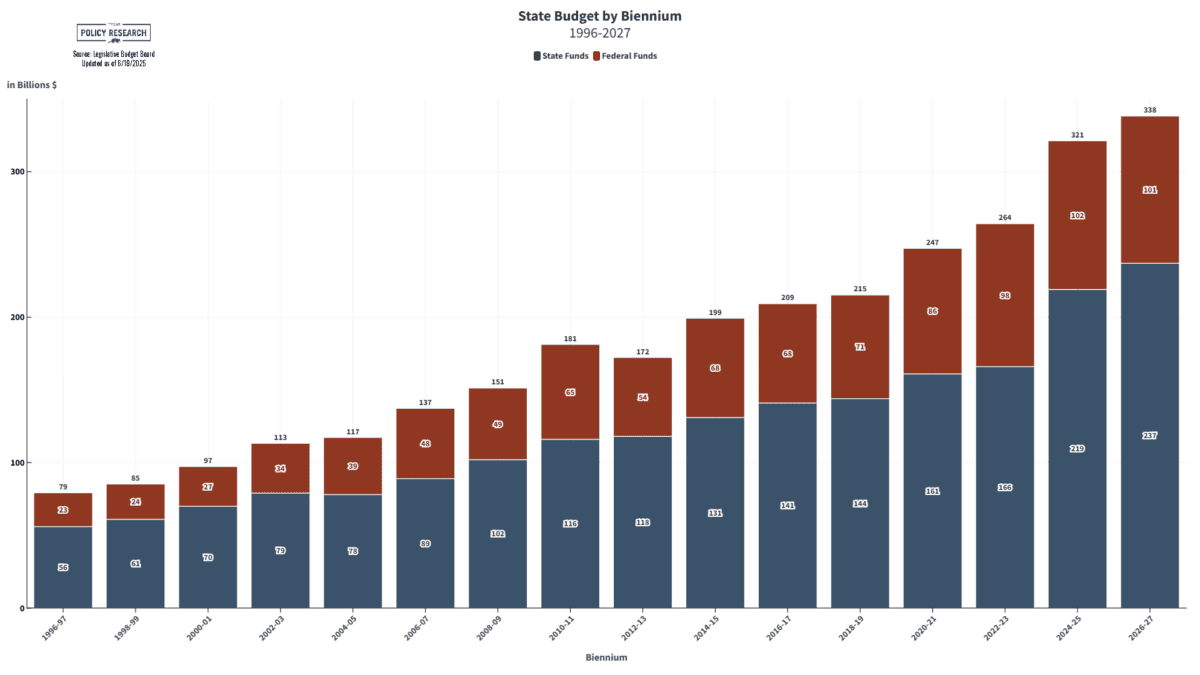
This is why state-funded property tax relief cannot be treated as costless. Every dollar used to reimburse school districts is a dollar collected from the broader tax base or unavailable for another purpose. Without corresponding spending restraint at both the state and local levels, Texas risks building an increasingly expensive system in which the state continually spends more to offset taxes that local governments continue imposing.
This distinction reveals the growing cost of maintaining the Legislature’s previous promises. Texas must appropriate tens of billions of dollars every biennium merely to keep earlier compression and exemption policies in place. The state initially projected that maintaining previous relief commitments would cost approximately $22.3 billion. That maintenance cost has now grown to roughly $44.5 billion.
Texas is spending nearly twice as much merely to preserve relief already promised while total property tax levies continue climbing. This is what TPR calls the property tax relief "treadmill."
The state collects growing amounts of sales taxes and other revenue, then commits that money to preventing school property tax rates from returning to previous levels. Meanwhile, local spending, property values, tax levies, and debt continue rising underneath the relief.
Calling the full $51 billion a new tax cut obscures this reality. Most of that money is maintaining past reforms rather than moving Texas substantially closer to property tax elimination.
Texas Property Tax Levies Keep Growing
The hearing’s presentation included a statistic that complicates declarations of historic Texas property tax relief.
Total statewide property tax levies increased from approximately $48.8 billion in 2014 to more than $89.4 billion in 2025. That represents an 83.25 percent increase. State sales tax revenue increased by a similar 79.14 percent during the same period. Bettencourt presented that comparison as evidence that Texas has converted growing state revenue into local property tax relief. But similar growth rates do not demonstrate that the property tax burden has been controlled. They show that Texans are surrendering substantially more money through both tax systems.
The long-term trend is unmistakable. Although school tax compression has restrained the growth of school district levies in recent years, the combined amount collected by school districts, cities, counties, and special-purpose districts remains near a record high.
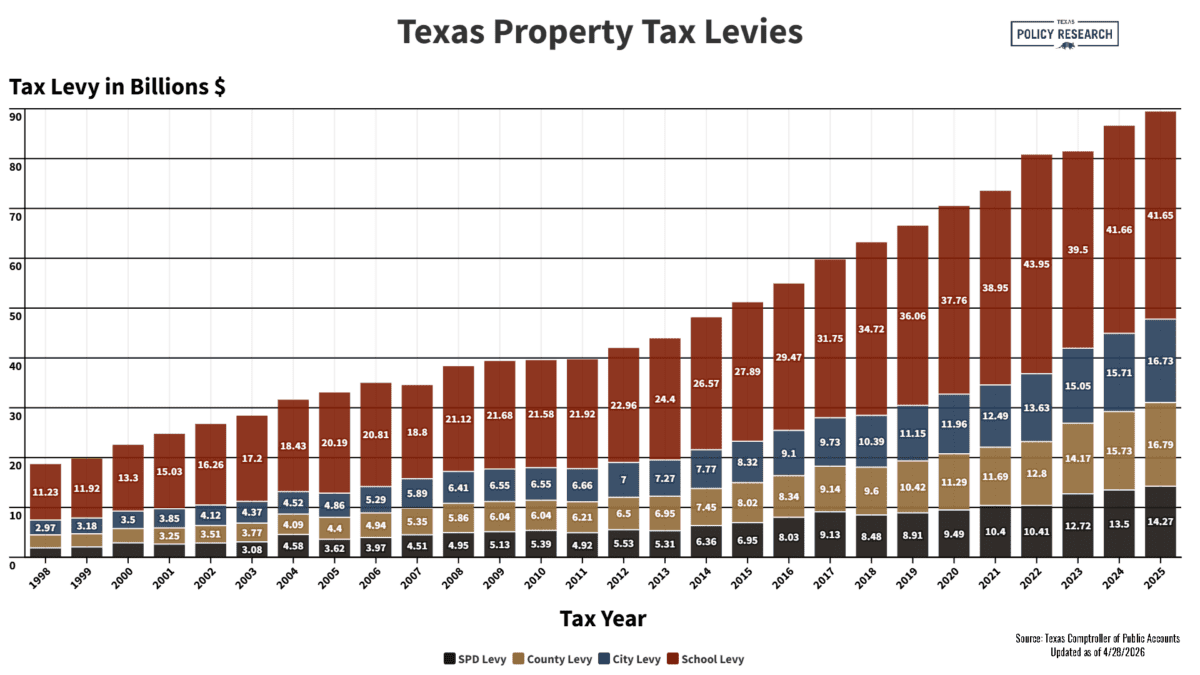
This chart places the hearing’s claims of historic property tax relief in their proper context. Individual homeowners may be paying less in school property taxes because of compression and larger exemptions, but Texas property owners collectively remain subject to a historically large property tax levy. Relief on selected tax bills is meaningful, but it is not the same as reducing the total cost of local government.
Texas property tax levies increased from approximately $48.8 billion in 2014 to $89.4 billion in 2025, an increase of more than 83 percent. Across the chart’s full 1998–2025 period, the statewide levy increased by roughly 350 percent, substantially outpacing the combined growth of population and inflation.
Since 1998, Texans have paid approximately $1.34 trillion in property taxes to school districts, cities, counties, and special-purpose districts.
Total Texas property tax levies grew by more than 378 percent between 1998 and 2025. Population growth and inflation combined increased by approximately 210 percent during the same period. Had property tax levies merely tracked population and inflation, Texans would have paid approximately $58 billion in 2025. Instead, local taxing units collected $89.4 billion.
The resulting $31.5 billion difference is the government spending problem made visible. It represents property tax collections beyond what population growth and rising prices alone would justify.
The aggregate statewide property tax burden equaled approximately $2,827 per Texas resident in 2025, compared with $928 in 1998. Adjusted for inflation, the per-resident burden still increased by approximately 54 percent.
These are measures of the aggregate statewide burden, not the bill paid by every individual Texan. But they reveal a structural trend that cannot be dismissed as the product of population growth or inflation. Texas government is collecting property taxes faster than the economic fundamentals justify.
The Low-Tax Texas Paradox
Texas is frequently described as a low-tax state because it does not impose an individual income tax. That reputation provides little comfort to Texans facing some of the nation’s highest property taxes.
Texas’s effective property tax rate is approximately 1.49 percent, ranking eighth-highest nationally and second-highest among the nine states without an individual income tax. Only New Hampshire ranks higher among states in that group, and New Hampshire does not impose a general sales tax.
Whatever Texas may claim as a low-tax state, the burden imposed on continued property ownership remains among the nation’s highest. This matters because property taxes function differently from taxes on income or consumption. They impose a recurring government claim on ownership itself.
A Texan who has fully paid off a mortgage must continue paying property taxes indefinitely. Failure to do so can ultimately result in the loss of the property. That makes property tax reform more than a budgeting question. It is a private property rights issue.
School Property Taxes Remain the Largest Burden
School district property taxes reached approximately $41.65 billion in 2025 and remain the largest single component of the Texas property tax system.
Since 1998, school district levies have increased by approximately 271 percent. Although the hearing documented a slight statewide decline from 2024 to 2025, school taxes still account for nearly half of all property tax levies.
Total statewide levies also increased by approximately 34 percent between 2019 and 2025, from $66.5 billion to $89.4 billion, despite the state’s expanding property tax relief commitments.
This does not mean compression failed. Taxpayers would have paid more without it. It means relief has been forced to operate against continued government spending and levy growth. Texas is spending tens of billions of dollars to hold down one portion of the tax system while the larger burden continues expanding.
That is not a reason to abandon compression. It is a reason to pair compression with enforceable spending restraint and use it to eliminate the school M&O tax rather than permanently subsidize an ever-growing system.
Local Spending Erodes Property Tax Relief
Bettencourt’s presentation showed that average annual property tax levy growth between 2019 and 2024 was 8.19 percent for cities, 9.65 percent for counties, and 10.30 percent for special-purpose districts. School district levy growth averaged 3.21 percent.
Those figures demonstrate why Texans may not feel the full effects of state-funded school tax relief.
The Legislature can spend billions compressing school district tax rates, but cities, counties, and special districts can absorb part of the benefit through higher spending and larger levies. Texans experience the combined property tax bill, not the policy achievements of each taxing unit in isolation.
Texas imposes several constitutional and statutory spending limits on state government. Local governments are not subject to an equivalent comprehensive spending limit. Meaningful property tax reform must address both sides of the tax equation. Texas does not merely have an appraisal problem or a revenue problem. It has a government spending problem.
Local Debt Makes Taxes Harder to Reduce
Local government debt adds another complication that the focus on homestead exemptions frequently overlooks.
Cities, counties, school districts, municipal utility districts, and other local entities issue bonds that commit property taxpayers to years or decades of principal and interest payments.
School tax rate compression generally targets maintenance and operations taxes. It does not eliminate existing interest and sinking fund obligations used to repay school district debt.
Once local debt is issued, debt service becomes a durable obligation. State relief may lower one portion of a property tax bill, but outstanding debt establishes a floor beneath which the total burden cannot easily fall.
New borrowing then raises that floor.
This explains why state-funded property tax relief can be real and still feel temporary. Austin compresses school M&O rates while local governments approve new spending and issue additional debt. The relief is gradually absorbed into obligations that can last 30 or 40 years.
Transparency is valuable, but disclosure alone cannot restrain local borrowing. Lawmakers should consider stronger voter protections, clearer disclosure of total repayment costs, limits on non-voter-approved debt, and meaningful guardrails tied to population growth and inflation.
Without addressing local spending and debt, future property tax relief packages will confront the same problem.
Abbott’s Plan Moves Toward Reform
Gov. Greg Abbott’s (R) broader property tax agenda at least recognizes that exemptions alone cannot solve the problem.
His proposals have included local government spending limits, stronger voter-approval requirements for tax increases, citizen-initiated rollback elections, appraisal reforms, and a long-term objective of eliminating school property taxes.
The strongest portions of that framework move the debate closer to the underlying drivers of the burden. Limiting spending growth forces governments to prioritize. Strengthening voter approval protects taxpayers from automatic increases. Compression reduces tax rates broadly. Elimination addresses the fundamental problem of taxing Texans merely for continuing to own property.
Other portions require caution. Tighter appraisal caps and less frequent reappraisals can create unequal treatment between longtime owners and new buyers, discourage mobility, and redistribute the tax burden without reducing government spending.
The value of Abbott’s plan ultimately depends on whether lawmakers enact and enforce its structural components rather than settling for another round of appraisal or exemption gimmicks.
Any effort to eliminate school property taxes must also extend beyond residence homesteads. Leaving businesses, rental properties, and other property owners subject to the tax would create another preferential exemption rather than eliminate the tax itself.
Texas Can Replace Property Taxes Responsibly
The first question in any property tax elimination debate should not be how government can replace every dollar it currently collects. Lawmakers should first determine what government should be funding and how much it should cost. Replacing an unnecessarily large property tax system dollar for dollar would preserve the same spending problem under a different tax.
Texas should restrain state and local spending, dedicate recurring revenue growth and available surpluses to compression, retire unnecessary obligations, and modernize the tax system around a broader and more transparent consumption-based model.
A responsible replacement strategy should scrutinize government spending before identifying the revenue needed to fund essential services. If replacement revenue remains necessary, it should tax voluntary consumption rather than continued property ownership.
Texas should not simply raise the sales tax dramatically while allowing government spending to continue growing unchecked. Nor should it adopt a complicated value-added tax that conceals the cost throughout the production process.
Once property taxes are eliminated, Texans should protect that achievement through a constitutional prohibition preventing a future Legislature or local government from restoring the tax under another name. The objective should be less government dependence on taxpayers, not merely a different method of collecting the same amount.
The Hearing Revealed Relief and Unfinished Work
The Senate Local Government Committee hearing documented meaningful reductions in average school district property tax bills. Bettencourt and other lawmakers deserve credit for the compression that helped produce those reductions.
The committee’s statewide data also provide valuable insight into how many homesteads now pay no school district property taxes and how the effects vary among general, over-65, and disabled homesteads.
But the cost of government did not disappear when homeowners received lower bills. It moved from their local school tax bills to the state budget and the broader body of taxpayers supporting it.
Seniors remain affected by taxes outside the school system and by property taxes embedded throughout the economy. Renters and businesses receive no homestead exemption. Local spending continues growing. Local debt creates obligations lasting decades. Total property tax levies remain approximately $31.5 billion above what population and inflation would justify.
Most importantly, the hearing did not establish that continually increasing the homestead exemption offers a sustainable path to property tax elimination.
The Texas Liberty Compact calls for eliminating property taxes and limiting local spending and debt, not merely redistributing the burden among different taxpayers or replacing it with a growing state obligation.
Texas should continue compressing school district M&O tax rates, restrain state and local government spending, strengthen voter protections, address local debt, and prevent local taxing units from erasing state-funded relief.
The hearing demonstrated that Texas has delivered real property tax relief. It also demonstrated how far Texas remains from true property tax reform.
Compress the rate. Discipline the spending. Eliminate the tax. Anything less merely rearranges which Texan pays the bill.
Support Our Work
Texas Policy Research relies on generous donors across Texas. If you found this helpful, please consider supporting our efforts.
Donate TodayStay in the Loop
Subscribe for occasional emails with new research, event details, and ways to engage with Texas policy.
Subscribe for Updates
